South-East Growth Corridor · Berwick 3806
Underpinning & foundation repair in Berwick
Berwick is built on hills, and estate housing on hills means cut and fill. Almost every foundation problem we see in the newer parts of Berwick traces back to a building platform that was carved out of a slope, with half the house sitting on undisturbed ground and half sitting on fill that is still finding its level.
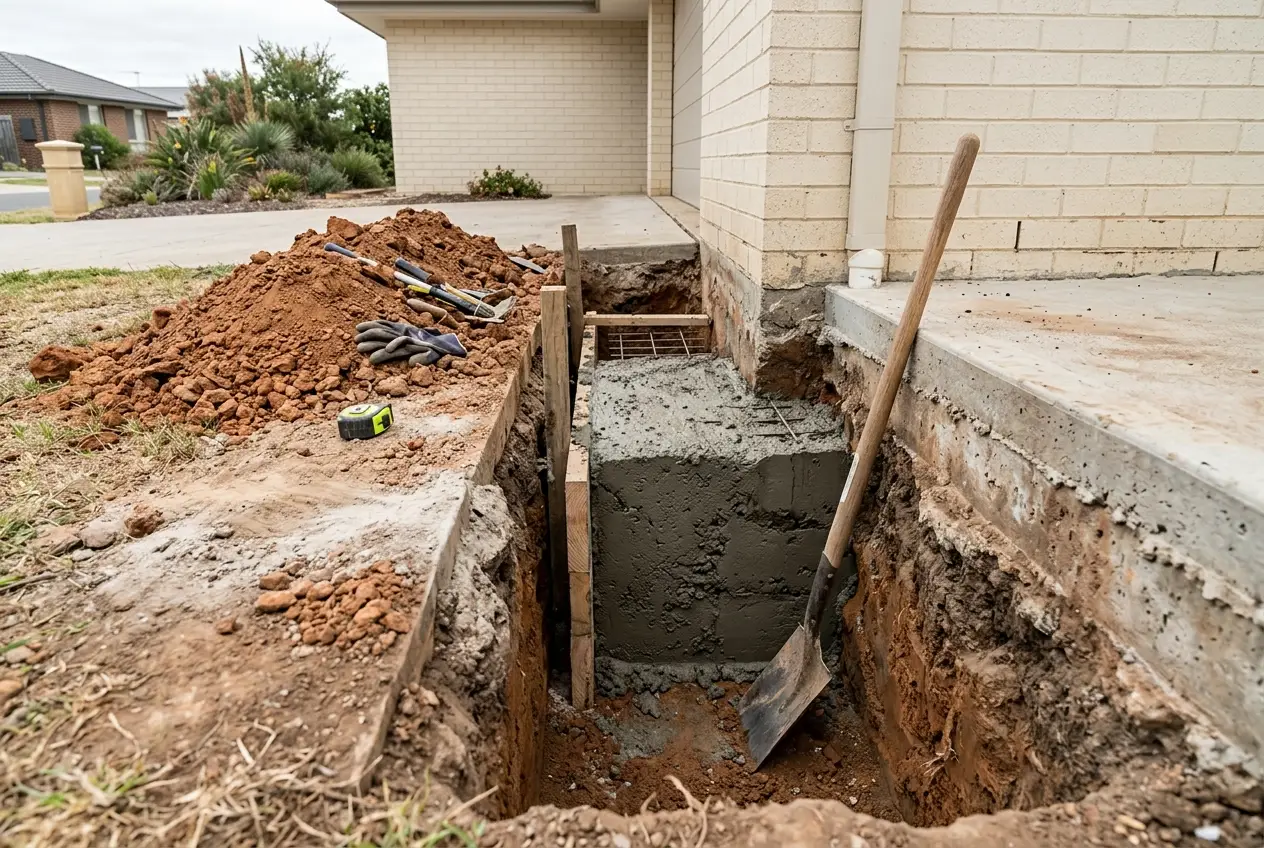
Berwick housing — what we are usually dealing with
Berwick has an old village core with genuinely historic buildings, but the housing that generates foundation work is the estate development from the early 1990s onward — brick veneer on waffle-pod and stiffened raft slabs, built under AS 2870, spreading up the hills to the north and east. The earliest of those estates are now over thirty years old, which is exactly the age at which cumulative seasonal movement, matured landscaping and three decades of drainage maintenance decisions start showing up in the brickwork. Two-storey homes are common in the later estates and are less tolerant of differential movement than single-storey.
The ground under Berwick
Berwick sits in the foothills, on sediments weathering into clay soils that are reactive to varying degrees — site classifications through the estates are commonly H1 and in places H2 under AS 2870. But the soil classification is only half the story here, because the slope is the other half. Creating a level building platform on falling ground means cutting into the hillside on the high side and placing engineered fill on the low side. Fill consolidates over years; undisturbed ground does not. A slab spanning both experiences differential settlement that has nothing to do with soil reactivity at all, and everything to do with how the site was prepared.
What this means for your job
The Berwick diagnosis therefore has to answer two questions rather than one: is this reactive clay moving seasonally, or is this fill still consolidating, or both? They produce different crack patterns. Seasonal clay movement affects the perimeter and reverses with the seasons. Fill consolidation produces a one-way settlement concentrated on the downhill side, often with a fairly straight crack line marking the cut-fill boundary. Retaining walls on the downhill side of Berwick blocks are a third factor worth checking — a failing or overloaded retaining wall changes the ground conditions under the slab edge it supports.
What we see in Berwick homes
- Cracking concentrated on the downhill side of the house
- A straight crack line through brickwork marking where cut meets fill
- Settlement that has continued steadily rather than moving back and forth with the seasons
- A retaining wall on the low side leaning, cracking or showing signs of overload
Underpinning costs in Berwick
$18,000 – $40,000 for a typical underpinning jobPriced per pier at $1,500 to $3,500 each, commonly eight to fifteen piers. Berwick trends toward the upper part of the range because piers on the filled side must be founded below the fill into competent natural ground, and on a deep-cut platform that can be a long way down. A geotechnical report establishing fill depth is not optional here — it is the single number that determines the price, and quoting without it is guesswork.
Indicative range only, based on typical jobs in this area. Access, soil conditions and the extent of movement change the number — a fixed price follows an on-site inspection.
The right service for Berwick
Berwick is a slab-on-ground suburb, so there are no stumps to replace here — the service that applies is underpinning and foundation repair. Anyone offering you "restumping in Berwick" has not looked at what your house is built on. See how we assess slab movement, and how heave differs from settlement, on our underpinning page.
Underpinning in Berwick — your questions
How do I know if my Berwick house is on fill?
The site plan and the soil report from the original build will say, if you can get them — the vendor, the builder or the council may hold them. Failing that, the topography tells you a lot: if your block falls and the house sits on a flat pad, someone made that pad, and the low side is almost certainly fill. A retaining wall along one boundary is a strong indicator. The definitive answer comes from a geotechnical investigation, which on a sloping Berwick block is money well spent before anyone quotes piers, because fill depth is what drives both the design and the price.
Is fill settlement covered by the builder's warranty?
It may be, depending on the age of the home and what actually went wrong. In Victoria, domestic building work carries a statutory warranty period of ten years for structural defects, and inadequate site preparation or footing design can fall within that. The practical difficulty is proving the cause, which is why documentation matters: get a floor level survey, get an engineer's opinion in writing, keep photographs with dates, and act promptly rather than watching it for three years. If the home is under ten years old, that avenue is worth investigating before you commit to paying for the repair yourself.
My retaining wall is leaning — is that connected to the house cracking?
It can be, and on a Berwick block it is worth investigating together rather than separately. A retaining wall on the downhill side is holding back the fill that part of your slab bears on. If the wall is moving, rotating or losing drainage, the material behind it is moving too, and the slab edge above it loses support. Repairing the house without addressing the wall means the same movement continues. It also works the other way — a wall with blocked drainage holds water against the fill, which changes moisture conditions under the slab.
We also work near Berwick
Worth reading next: Reactive clay in Melbourne's west, explained