Service · Damp & subfloor moisture
Rising damp in Melbourne homes
Rising damp is the most over-diagnosed problem in Australian housing. It is real, and we treat it — but in the majority of homes we assess, the damp at the base of the wall turns out to be a garden bed, a downpipe or a blocked subfloor vent. Those cost a few hundred dollars to fix, not a few thousand.
What genuine rising damp actually looks like
Rising damp is groundwater drawn up into porous masonry by capillary action. Capillary rise against gravity has a practical ceiling, which is why real rising damp has such a consistent signature:
- It stops around a metre up. Damp reaching two metres is not rising damp.
- The upper edge is roughly level, often with a visible tide line where salts have crystallised.
- Salt staining and efflorescence — a white crystalline bloom — because the water carries ground salts with it and leaves them behind as it evaporates.
- It is there year-round, not only after rain.
- It affects walls in ground contact, and typically the base of skirtings, plaster and paint perish along that band.
The four things routinely mistaken for it
- A bridged damp course. By far the most common. Garden beds, mulch, raised paving, a concrete path or render carried down over the damp proof course give moisture a route straight around a damp course that is working perfectly well. Fix: lower the ground, cut the render back, restore clearance. Often a few hundred dollars.
- Lateral damp. Moisture pushing through a wall from higher ground or fill on the other side — common on sloping blocks and against retaining situations. Signature: damp on one wall only, the one with ground behind it, at any height rather than confined to the base.
- Leaks. A downpipe discharging against the wall, a cracked stormwater line, a failed shower waterproofing membrane, a leaking supply pipe. Signature: a defined patch that does not respect ground level, often worse after rain or after the shower is used.
- Condensation. Warm moist air meeting cold surfaces. Signature: worst in winter, concentrated in corners, behind furniture and on external-facing walls, often with mould rather than salt.
How we assess it
- Moisture readings at multiple heights up the wall, which is how the profile of the damp is established rather than guessed.
- External ground levels. Where is the damp proof course, and is the soil, paving or render sitting above it? This single check resolves a large proportion of cases.
- Drainage and downpipes. Where does the roof water actually go, and does the ground fall away from the house?
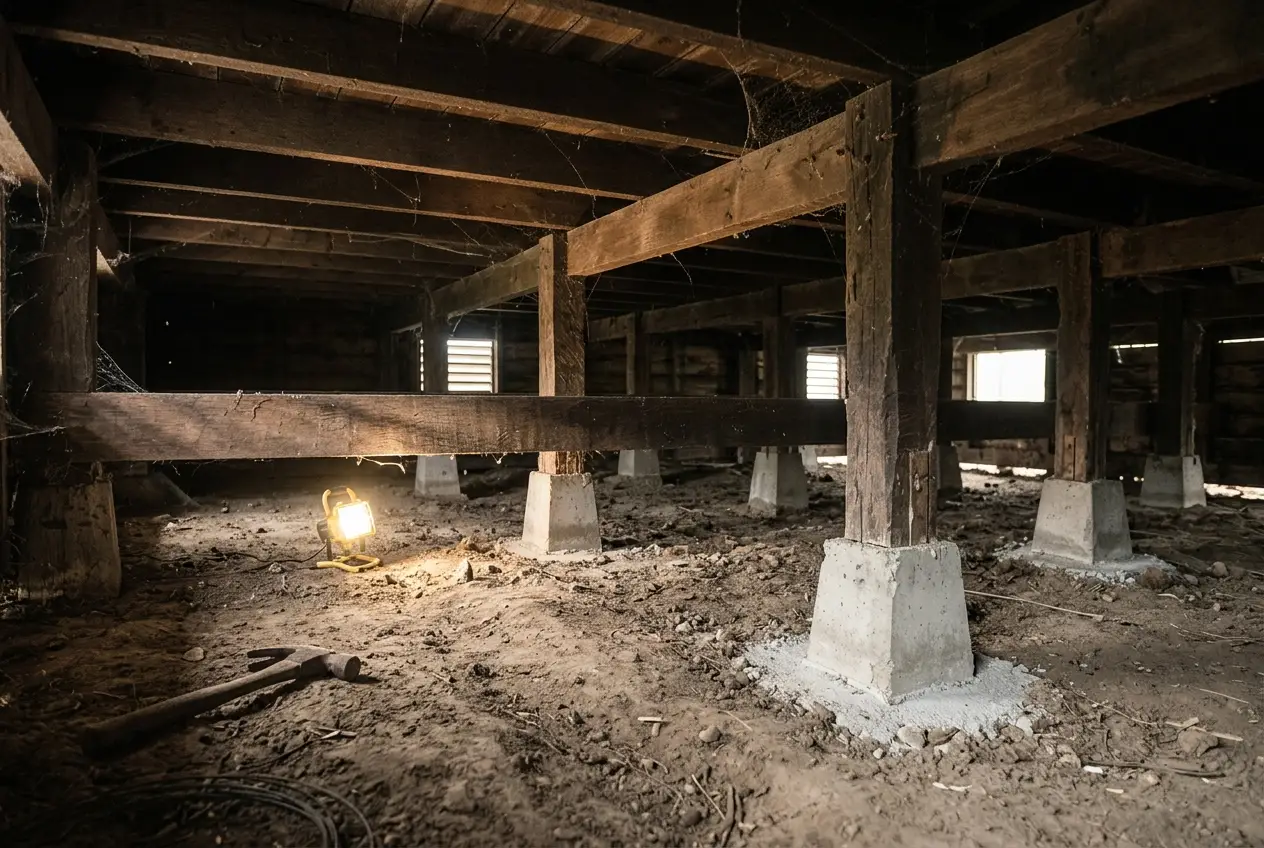
- Subfloor inspection. Ventilation, ground moisture, and the condition of the stumps and bearers — which is frequently where the same water is doing more expensive damage.
- Salt analysis where it matters, because ground salts and salts from a plumbing leak are not the same and point at different sources.
Treatment, in the order we recommend it
- Correct the ground and drainage first. Lower garden beds and paving below the damp course, cut back bridging render, redirect downpipes, restore fall away from the house.
- Restore subfloor ventilation. Unblock painted-over or buried vents, add vents where cross-flow is inadequate. Cheap, and it protects the stumps as well as the walls.
- Chemical damp proof course injection where a genuine failed or absent damp course has been demonstrated — not as a default.
- Remove and replace salt-contaminated plaster, with a salt-retardant render system where required. Salts left in the wall will keep drawing moisture and blooming through new paint.
- Address the timber. Where prolonged damp has attacked stumps, bearers or joists, that is a restumping or floor levelling conversation.
What damp treatment costs in Melbourne
$300 – $1,500 drainage & ventilation · $2,500 – $8,000 chemical damp courseCorrecting ground levels, clearing garden beds, redirecting downpipes and restoring subfloor ventilation typically runs $300 to $1,500 and resolves a large share of the cases we see. Injected chemical damp proofing on a genuinely failed course runs roughly $150 to $300 per linear metre of wall, so $2,500 to $8,000 on a typical house, plus replastering. We will always quote the cheap fix first if that is what the readings support.
Indicative range only, based on typical jobs in this area. Access, soil conditions and the extent of movement change the number — a fixed price follows an on-site inspection.
Rising damp questions, answered properly
How do I know it is rising damp and not something else?
Genuine rising damp has a specific signature: it is confined to the lowest part of the wall, typically no more than about a metre above ground level because that is roughly the height capillary action can lift water against gravity; it has a fairly level upper edge, often with a visible tide line of salt; it is present year-round rather than appearing after rain; and it affects walls in contact with the ground. Damp that starts higher up, appears only after rain, has a defined patch shape, or affects an internal wall away from the ground is something else — and something else is the more likely answer in most Melbourne homes.
What gets mistaken for rising damp?
Four things, and between them they account for most of the cases we assess. Bridged damp course: garden beds, paving, render or a concrete path built up above the damp proof course, letting moisture bypass it — extremely common and often cheap to fix. Lateral damp: moisture coming through a wall from higher ground or a retaining situation on the other side. Plumbing and rainwater leaks, which produce damp patches that do not respect ground level. And condensation, which affects cold surfaces and corners and is worst in winter in poorly ventilated rooms. Each has a different fix, and none of them is a chemical damp course.
Do older Melbourne homes have a damp proof course?
Most Melbourne housing built from the 1880s onward does have one, usually a layer of slate, bituminous felt or engineering brick a couple of courses above ground level. They frequently still work. The reason damp appears in these houses is usually not that the damp course is absent but that it has been bridged — a hundred years of garden beds, added paving, raised driveways, render carried down over the course and concrete paths poured against the wall have given moisture a route around it. Establishing whether the course exists and where it sits is the first thing to check, and it is often visible from outside.
Is a chemical damp course injection worth doing?
Where genuine rising damp is confirmed and the original damp course has failed rather than been bridged, injected chemical damp proofing is an established remedy and it works. The caution is that it is routinely sold for problems it cannot solve. Injecting a chemical course into a wall whose real problem is a garden bed built above the existing damp course, a leaking downpipe or condensation achieves nothing except cost. Insist that the diagnosis is demonstrated — moisture readings at multiple heights, an inspection of the external ground levels — before agreeing to injection.
Is rising damp connected to my stumps or foundations?
They share a cause more often than people realise: water sitting where it should not. A subfloor that stays damp because of poor drainage, blocked vents or ground levels built up against the house is simultaneously rotting timber stumps and keeping the base of the walls wet. In Melbourne's low-lying inner suburbs we regularly find both problems in the same house from the same source. That is why our assessment looks at ground levels, drainage and subfloor ventilation together rather than treating damp as purely a wall issue.
Can I fix rising damp myself?
You can very often fix what is actually causing it, which is not the same as treating rising damp. Clearing garden beds and mulch away from the wall, lowering built-up soil so it sits well below the damp course, unblocking or adding subfloor vents, redirecting a downpipe, and making sure paving falls away from the house are all genuinely effective and mostly cost nothing but a Saturday. In a good proportion of the houses we assess, that is the entire fix. What is not a DIY job is diagnosing a genuinely failed damp course or removing and replastering salt-contaminated walls.
Related:Restumping & reblocking ·Signs your house needs restumping ·Can a leaking pipe make a house sink?