Wyndham · Hoppers Crossing 3029
Underpinning & foundation repair in Hoppers Crossing
Hoppers Crossing is at an awkward age. The bulk of it was built through the 1980s and early 1990s, which means the housing is now thirty to forty years old — long enough for shallow footings on reactive clay to have accumulated real movement, but generally too old for any warranty to help.
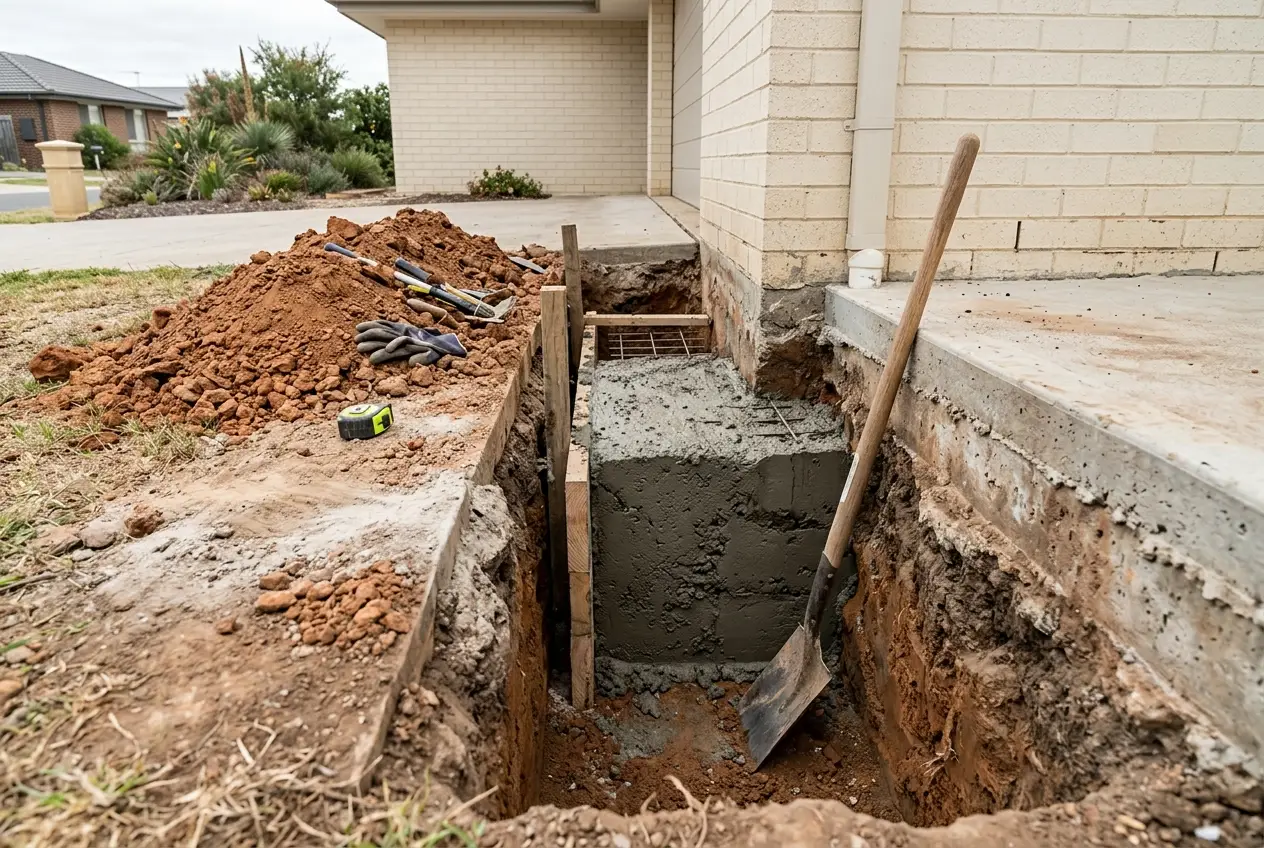
Hoppers Crossing housing — what we are usually dealing with
Hoppers Crossing filled in largely between the late 1970s and the mid 1990s, and it is dominated by single-storey brick veneer on concrete slab or shallow strip footings, on standard suburban blocks. That construction era sits in a specific gap: modern enough to be slab-on-ground rather than stumped, but built before reactive-site footing design was applied as rigorously as it is today. Many of these homes also have later additions — a family room, a covered pergola, a converted garage — typically built on their own separate slab or footing, and it is very often the junction between the original house and that addition that cracks first.
The ground under Hoppers Crossing
The suburb sits on Werribee plains clay, moderately to highly reactive, on flat ground with limited drainage fall. Thirty-five years of seasonal wetting and drying is a long time for a shallow footing to stay put, and the mature landscaping that comes with a suburb of this age — established trees, decades-old garden beds against the house, paving that has settled and now falls back towards the slab — all concentrate moisture unevenly around the perimeter.
What this means for your job
The junction cracks are the practical thing to watch in Hoppers Crossing. When an addition is built on its own footing beside an existing house, the two structures are independent and move independently on reactive clay, so a crack opens at the join. That is not always a structural emergency — sometimes it is a movement joint doing exactly what it should, and the right fix is a properly detailed articulation joint rather than underpinning. Knowing which is which saves a great deal of money. Where a genuine full underpin is warranted on an older shallow-footed home, it is generally a smaller job than the deep-fill work required out in the newer corridor estates.
What we see in Hoppers Crossing homes
- A vertical crack opening at the junction between the original house and a later addition
- Cracking in a converted garage or family-room wall that does not appear elsewhere
- Paving or a driveway that has settled and now falls back towards the house
- Long-standing hairline cracks that have recently started widening again
- Doors in one section of the house binding while the rest of the house is unaffected
Underpinning costs in Hoppers Crossing
$12,000 – $28,000 for typical underpinningPiers typically run $1,500 to $2,600 each, and shallow-footed homes of this era often need fewer of them than newer deep-fill sites. Where the issue turns out to be a junction between two independent structures, a properly detailed articulation joint and crack repair may cost $3,000 to $8,000 rather than a full underpin.
Indicative range only, based on typical jobs in this area. Access, soil conditions and the extent of movement change the number — a fixed price follows an on-site inspection.
The right service for Hoppers Crossing
Hoppers Crossing is a slab-on-ground suburb, so there are no stumps to replace here — the service that applies is underpinning and foundation repair. Anyone offering you "restumping in Hoppers Crossing" has not looked at what your house is built on. See how we assess slab movement, and how heave differs from settlement, on our underpinning page.
Underpinning in Hoppers Crossing — your questions
The crack is where my extension joins the house — is that serious?
Not necessarily, and this is the most common enquiry we get from Hoppers Crossing. An addition built on its own separate footing is a structurally independent building sitting beside yours, and on reactive clay the two will move independently no matter how well built they are. A crack at the join is often just that movement being expressed. The question is whether it is stable seasonal movement — in which case a properly detailed articulation joint and flexible sealant is the right, and far cheaper, answer — or whether one structure is progressively dropping relative to the other, which needs underpinning. Measurement over time distinguishes them.
Are 1980s Hoppers Crossing homes built on inadequate footings?
Not inadequate for their time, but shallower than the same site would get today. Reactive-soil site classification and the footing design requirements in AS 2870 have been tightened and enforced more rigorously since much of Hoppers Crossing was built. Those original footings are frequently founded in the top zone of clay where seasonal moisture change is greatest, so they move with the ground. After thirty-five years of cycling, that accumulated movement is what people are now seeing in their brickwork.
Will my home insurance cover foundation repair in Hoppers Crossing?
Gradual earth movement is excluded under most Australian home insurance policies, so cracking that developed slowly over decades of seasonal clay movement is usually not covered. What can be covered is damage from a sudden, identifiable event — most commonly a burst or leaking pipe under or beside the slab washing out support. In a suburb where the plumbing is now thirty-plus years old, that is worth investigating properly rather than assuming. Get the cause documented by an engineer before you start repairs, because once the work is done the evidence is gone.
We also work near Hoppers Crossing
Worth reading next: Reactive clay in Melbourne's west, explained