South-East Growth Corridor · Clyde North 3978
Underpinning & foundation repair in Clyde North
Clyde North is built on some of the most reactive ground in metropolitan Melbourne — the heavy black clay of the old market gardens — and it produces the pattern that surprises homeowners more than any other: houses six or eight years old with cracking that looks like it belongs on a century-old building.
Clyde North housing — what we are usually dealing with
Clyde North is among the newest suburbs we cover, with the bulk of its housing built from roughly 2012 onward and construction still running. Everything is brick veneer on waffle-pod or stiffened raft slab, designed under AS 2870, and a large proportion is double storey on relatively compact lots. The houses are not old and they are not badly built — the ground is simply demanding, and a slab on highly reactive clay is designed to tolerate a substantial amount of movement rather than to prevent it. Landscaping is young, which means irrigation is heavy and drainage is often still bedding in.
The ground under Clyde North
The area's heavy clays, worked for generations as market garden land, are highly reactive. Site classifications through Clyde North estates are commonly H2 under AS 2870 and in places E — extremely reactive, the most demanding residential classification in the standard. That means the design anticipates very large seasonal ground movement, and the difference between a house that copes and a house that cracks is often not the slab but the moisture management around it. On ground this reactive, a single downpipe discharging at the slab edge is genuinely enough to move a house.
What this means for your job
Two pieces of Clyde North advice matter more than anything else. The first is that moisture control around the slab is not a nice-to-have here, it is the whole game: downpipes connected properly into stormwater, no garden beds watered daily against the wall, no irrigation lines running along the footing, and consistent moisture rather than a wet side and a dry side. The second is that most of these homes are still inside the ten-year structural warranty period, and a cracking house that is seven years old should be documented and raised with the builder before anyone considers paying for underpinning privately.
What we see in Clyde North homes
- Significant cracking in a house less than ten years old
- Stair-step cracks above windows and doors that widen toward the top — the heave signature
- Internal doors binding at the top corner in one part of the house only
- Cracking worst on the side with the garden bed, the irrigation line or the downpipe outlet
Underpinning costs in Clyde North
$18,000 – $42,000 for a typical underpinning jobPriced per pier at $1,500 to $3,500 each, commonly ten to eighteen piers on the reactive ground here. Clyde North sits at the top of our range because piers must be founded below the zone of seasonal moisture change, and on H2 and E-classified clay that zone is deep. Before spending it, exhaust the two cheaper paths: drainage and moisture correction, and the builder's structural warranty if the home is under ten years old.
Indicative range only, based on typical jobs in this area. Access, soil conditions and the extent of movement change the number — a fixed price follows an on-site inspection.
The right service for Clyde North
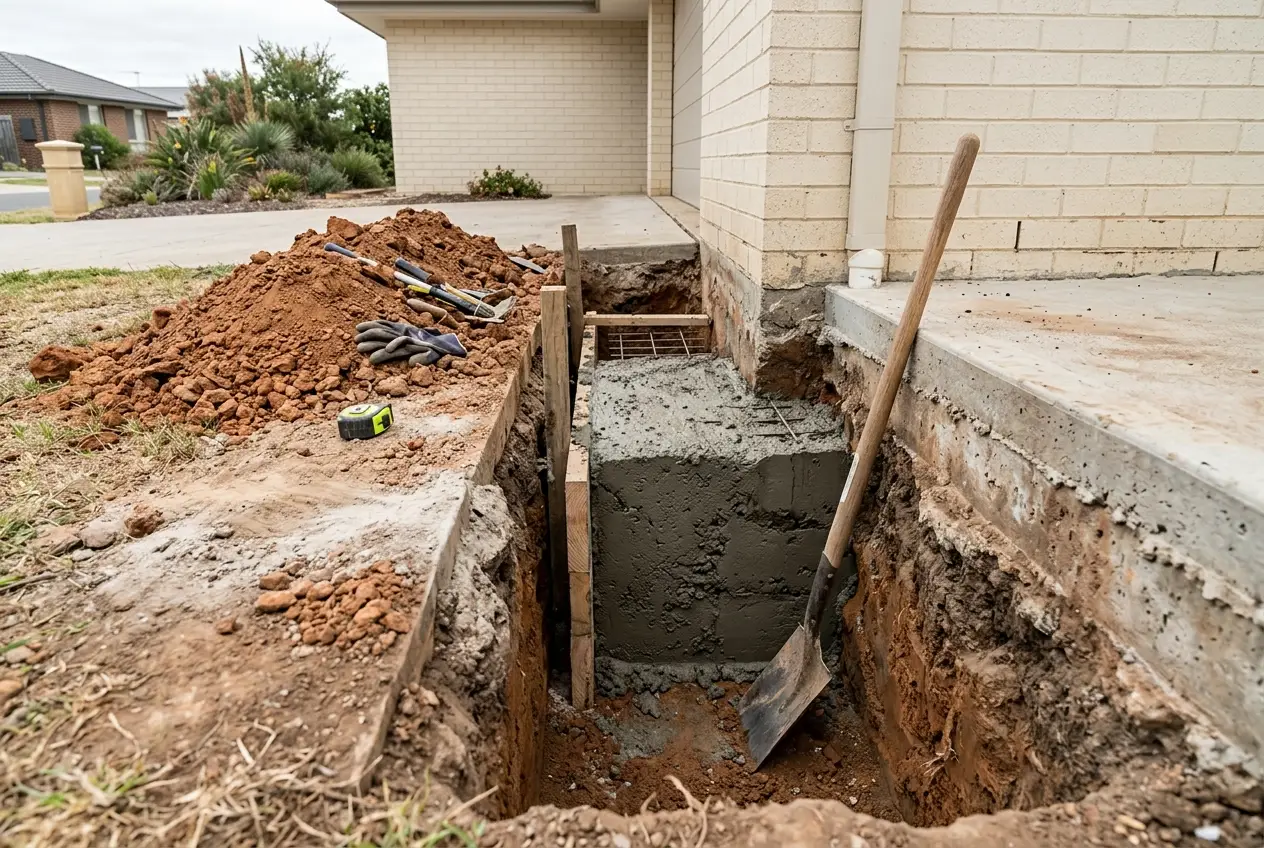
Clyde North is a slab-on-ground suburb, so there are no stumps to replace here — the service that applies is underpinning and foundation repair. Anyone offering you "restumping in Clyde North" has not looked at what your house is built on. See how we assess slab movement, and how heave differs from settlement, on our underpinning page.
Underpinning in Clyde North — your questions
My Clyde North house is only seven years old — why is it cracking?
Almost certainly because of the ground rather than the construction. Clyde North sits on highly reactive clay, commonly classified H2 and in places E under AS 2870, which means very large seasonal ground movement is anticipated by the design. A compliant slab is built to tolerate that movement, not to stop it, and what pushes a house past tolerance is uneven moisture — one side of the slab kept wet by irrigation, a garden bed or a downpipe while the other dries out. Age has little to do with it. On ground this reactive, the moisture regime in the first decade matters more than the decade itself.
Is this covered by the builder's warranty?
It is well worth pursuing if the home is under ten years old, which most Clyde North homes are. Victorian domestic building work carries a statutory ten-year warranty for structural defects, and questions about whether the footing design matched the site classification, or whether the site was classified correctly, fall squarely within that. Do it properly: commission an independent floor level survey and engineer's report, keep dated photographs of the cracks as they progress, and raise it with the builder in writing. Do not spend $30,000 on private underpinning before you have tested that avenue.
What can I do myself to stop the movement getting worse?
More than you would expect, and on ground this reactive it genuinely matters. Get every downpipe discharging into a stormwater connection rather than onto soil beside the slab. Remove or relocate garden beds and irrigation running against the house. Aim for consistent moisture right around the perimeter rather than a wet side and a dry side — that differential is what actually damages the building. Keep large trees away from the slab edge. Make sure surface levels fall away from the house. None of that reverses movement that has already happened, but it stops the cycle that is driving it, and on an H2 or E site it can be the difference between monitoring and underpinning.
We also work near Clyde North
Worth reading next: Reactive clay in Melbourne's west, explained