Wyndham · Tarneit 3029
Underpinning & foundation repair in Tarneit
Tarneit produces a question we hear constantly: why is a house built in 2014 already cracking? The answer usually involves two things unique to fast-growth corridors — highly reactive clay, and the deep engineered fill that was used to level former paddocks into buildable estate lots.
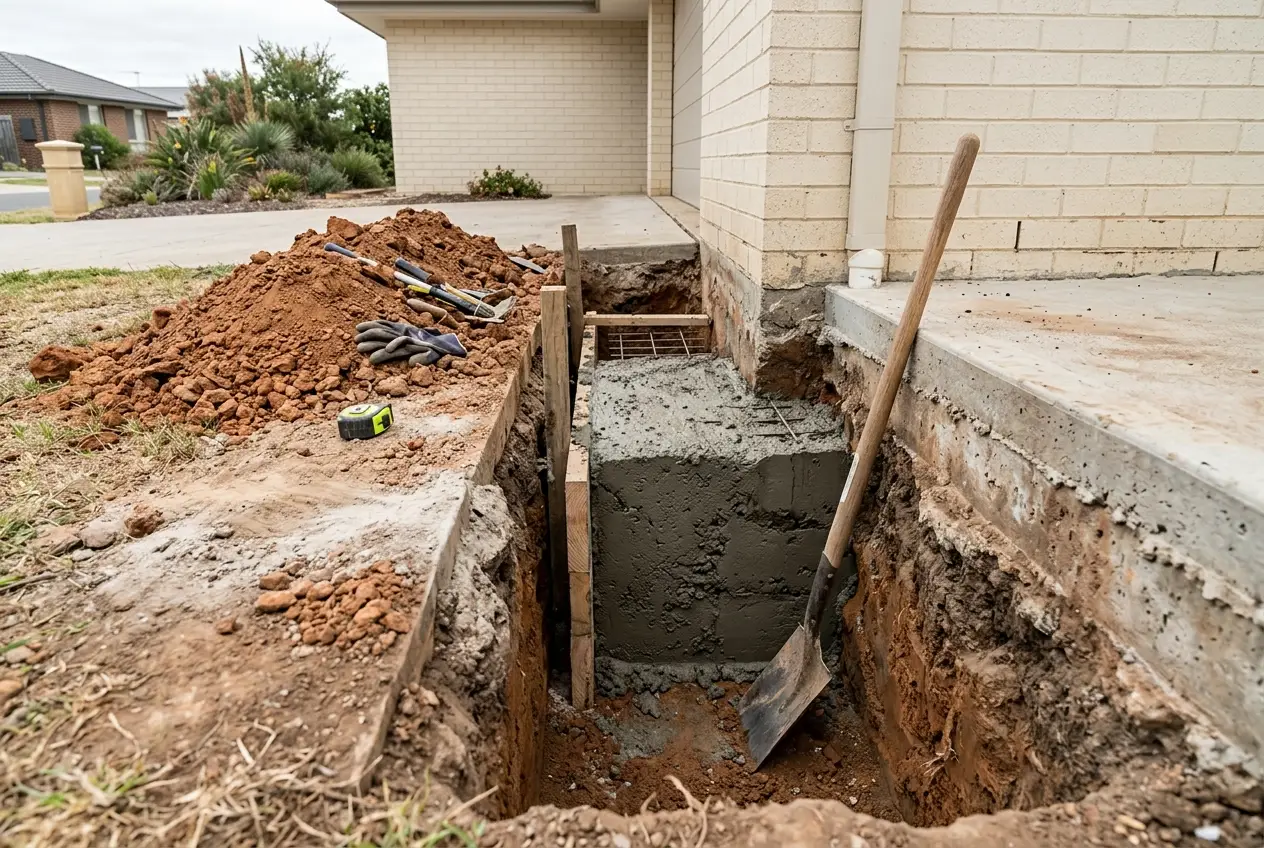
Tarneit housing — what we are usually dealing with
Tarneit went from farmland to one of Victoria's fastest-growing suburbs across the 2010s, and the overwhelming majority of its housing is under fifteen years old: brick veneer on waffle-pod slab, built to AS 2870, on compact lots with minimal setbacks. Homes this new should not be showing structural cracking, and when they do it is worth understanding why rather than accepting it. The compact lot sizes matter too: with only a metre or two between the slab edge and the boundary, downpipes, paving, garden beds and air-conditioning condensate all end up concentrated in a narrow strip right against the footings.
The ground under Tarneit
Two ground conditions overlap in Tarneit. The natural soil is reactive clay typical of the western plains. On top of that, turning gently undulating farmland into flat, buildable lots meant substantial cut-and-fill earthworks, so a meaningful number of Tarneit homes sit partly on natural ground and partly on engineered fill. Fill placed and compacted to specification performs perfectly well. Fill that was placed too deep, compacted inadequately, or that varies across a single lot does not — and a slab spanning the join between undisturbed ground and deep fill is the textbook setup for differential settlement.
What this means for your job
This is why a Tarneit assessment should start with the paperwork. The soil report and site classification from when the house was built, along with the fill depth records, tell you whether you are dealing with reactive clay behaviour, fill settlement, or a drainage fault — three different problems with three different fixes and three very different answers on who is responsible. If the home is under six years old, Victoria's domestic building insurance may still cover structural defects, which makes establishing the cause a financial question, not just a technical one. Underpinning through deep fill also needs piers taken right down to competent natural ground; piers founded within the fill itself will move with it.
What we see in Tarneit homes
- Structural cracking in a home less than fifteen years old
- Cracking concentrated along one line across the house, often where cut meets fill on the lot
- A step or separation between the house slab and an attached garage or alfresco slab
- Downpipes discharging into a narrow garden bed hard against the slab edge
- Neighbouring homes in the same estate showing similar cracking in similar locations
Underpinning costs in Tarneit
$16,000 – $38,000 for typical underpinningWhere piers must pass through deep fill to reach competent natural ground, they are longer and cost more — commonly $2,000 to $3,500 per pier in Tarneit. Get the site's soil report and fill records first: if the home is within the six-year structural defect window, the cost conversation may not be yours to have alone.
Indicative range only, based on typical jobs in this area. Access, soil conditions and the extent of movement change the number — a fixed price follows an on-site inspection.
The right service for Tarneit
Tarneit is a slab-on-ground suburb, so there are no stumps to replace here — the service that applies is underpinning and foundation repair. Anyone offering you "restumping in Tarneit" has not looked at what your house is built on. See how we assess slab movement, and how heave differs from settlement, on our underpinning page.
Underpinning in Tarneit — your questions
Why is my ten-year-old Tarneit house cracking?
Usually one of three causes, and they need to be told apart. Reactive clay movement — the natural soil swelling and shrinking seasonally. Fill settlement — the house sits partly on engineered fill placed when the estate was levelled, and that fill is consolidating unevenly. Or a drainage or plumbing fault putting water where it should not be. A house this new showing structural cracking is not normal wear, so it is worth getting the original soil report and site classification and having an engineer establish which of the three is actually happening before anyone quotes on repairs.
What does engineered fill have to do with my foundation?
Estates like Tarneit's were carved out of undulating farmland, and levelling the land into flat lots meant cutting high ground and filling low ground — sometimes several metres deep. Properly placed and compacted fill supports a house perfectly well. The trouble is variation: if one part of your slab sits on undisturbed natural ground and another on deep fill, the two settle at different rates and the slab has to bridge the difference. That shows up as cracking along a fairly defined line. It also means any underpinning has to take piers all the way down to competent natural ground, not stop within the fill.
Can I claim on builder's warranty for cracking in Tarneit?
Possibly, if the home is young enough. In Victoria, domestic building insurance covers structural defects for six years from completion, and cracking caused by a non-compliant slab design, an incorrect site classification or inadequately compacted fill can fall within that. You will need an independent engineer's report establishing the cause — not just evidence that cracks exist. Beyond six years the warranty path closes, though a plumbing leak causing sudden damage may still be an insurance matter. Either way, document it properly before starting repairs, because repairs destroy the evidence.
We also work near Tarneit
Worth reading next: Reactive clay in Melbourne's west, explained