South-East Growth Corridor · Narre Warren 3805
Underpinning & foundation repair in Narre Warren
Narre Warren's estates are old enough to have grown up. The homes built through the 1980s and 1990s now sit among mature trees, established gardens and thirty-year-old stormwater connections — and that combination of maturity is precisely what produces the slab movement we are called out for here.
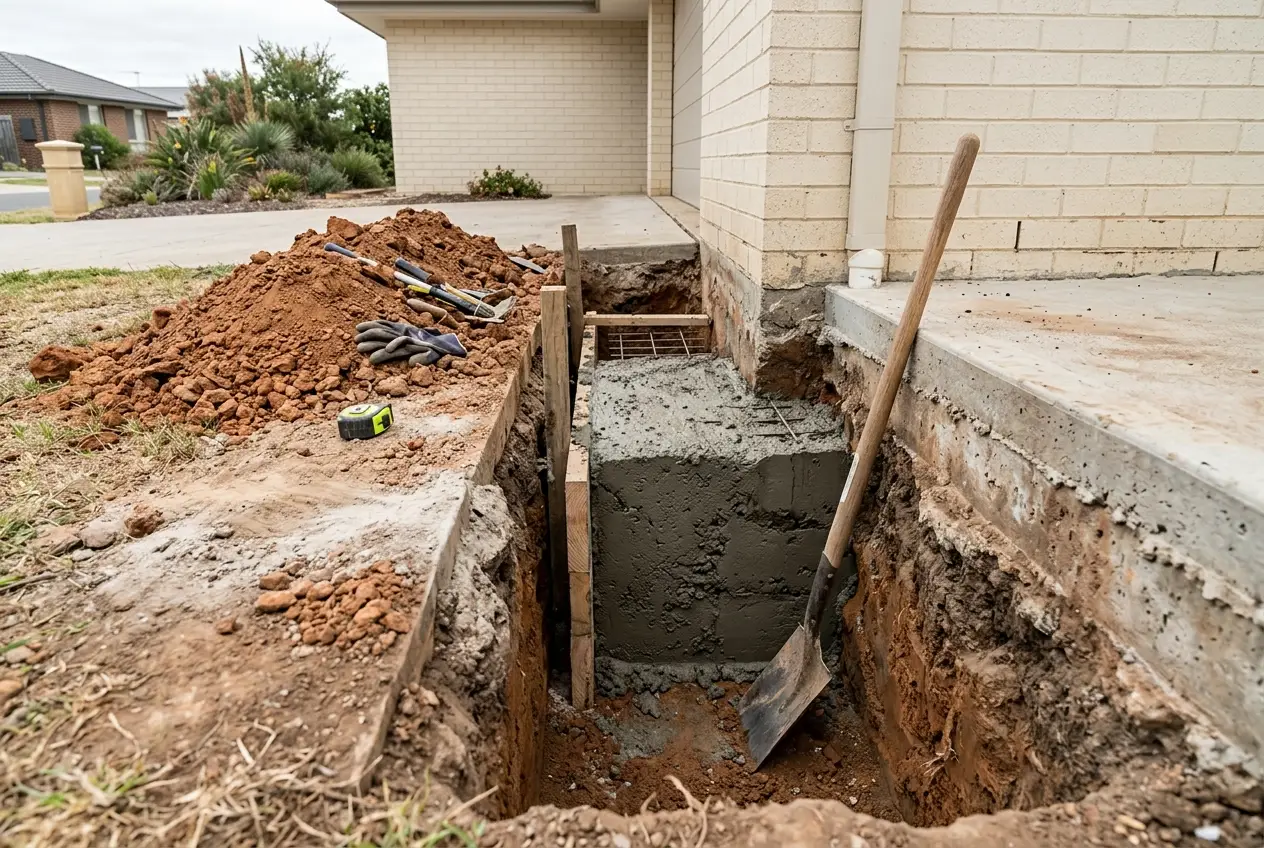
Narre Warren housing — what we are usually dealing with
Narre Warren is one of the earlier south-eastern growth suburbs, with substantial estate development from the early 1980s through to the 2000s and continued infill since. The stock is brick veneer on slab-on-ground, built under the AS 2870 framework of its era. That last point matters: slab design standards and site classification practice have tightened over the decades, so a 1985 slab and a 2015 slab in the same street were not designed to the same expectations of ground movement. The older estates are where we see the most work, and they are also where the landscaping has had forty years to mature.
The ground under Narre Warren
The area sits on clay soils of moderate to high reactivity, with site classifications through the estates commonly H1 and in places H2 under AS 2870. Reactive clay does not fail — it moves, seasonally and predictably, and a compliant slab is designed to ride that movement. What breaks the arrangement is anything that makes the movement uneven: moisture concentrated on one side of the house and not the other. In a mature Narre Warren estate that is usually a large tree drawing one zone dry, a garden bed watered daily against a wall, or a thirty-year-old stormwater line that has cracked.
What this means for your job
The single most useful thing about Narre Warren jobs is how often the cause is fixable. Before we quote piers, we look for the water: downpipes discharging at the slab edge rather than into stormwater, cracked or disconnected underground lines, irrigation running against the house, and mature trees within striking distance of a corner. A meaningful proportion of the houses we assess here need a plumber and a season of monitoring rather than fifteen piers, and getting that sequence right is the difference between a $3,000 fix and a $30,000 one.
What we see in Narre Warren homes
- Stair-step cracking through mortar joints above windows and doors
- Internal doors binding at the top corner while the bottom still clears
- Cracking concentrated on one side of the house — the side with the garden bed, the tree, or the downpipe
- Cracked floor tiles or a gap opening at the cornice in one room
Underpinning costs in Narre Warren
$16,000 – $34,000 for a typical underpinning jobPriced per pier at $1,500 to $3,500 each, commonly eight to fifteen piers. Narre Warren sits mid-range: the ground is reactive but the sites are generally flatter than Berwick's, so pier depths are more consistent and there is less fill to get through. The number that most often changes the outcome here is not the pier count — it is whether a drainage fix and a season of monitoring makes the piers unnecessary at all.
Indicative range only, based on typical jobs in this area. Access, soil conditions and the extent of movement change the number — a fixed price follows an on-site inspection.
The right service for Narre Warren
Narre Warren is a slab-on-ground suburb, so there are no stumps to replace here — the service that applies is underpinning and foundation repair. Anyone offering you "restumping in Narre Warren" has not looked at what your house is built on. See how we assess slab movement, and how heave differs from settlement, on our underpinning page.
Underpinning in Narre Warren — your questions
Why is my 1990s Narre Warren house cracking now?
Because the things around it have changed, not because the house has suddenly failed. Thirty years of seasonal clay movement is cumulative; landscaping planted at handover is now mature and drawing serious volumes of moisture; and stormwater and sewer lines installed in the 1990s are at an age where cracked joints and root intrusion become common. Any one of those shifts the moisture balance under one part of the slab, and a slab designed to tolerate uniform movement starts to experience uneven movement. The trigger is usually identifiable, which is good news, because identifiable often means fixable.
Should I fix the drainage before getting underpinning quotes?
Yes, and it may change what you need entirely. If a downpipe has been discharging into the soil at the slab edge or a stormwater line has cracked, that is putting thousands of litres into one zone of reactive clay, and it will keep doing so after you have paid for piers. The correct sequence is find the water, fix the water, monitor for a season, then decide on structural work. Some houses stabilise. Some have moved permanently and still need underpinning — but you will be underpinning against stable ground conditions rather than a moving target.
Can resin injection work instead of underpinning here?
Sometimes. Polyurethane resin injection suits a slab that is structurally sound where the problem is voids or loose soil beneath it rather than an inadequate footing, and it typically runs $5,000 to $15,000 against $16,000 or more for piers, with far less disruption. It is not a universal substitute — where the footing itself is inadequate for the ground conditions or the movement is deep-seated, resin will not carry the load and piers are the honest answer. The level survey and the crack pattern determine which case you are in.
We also work near Narre Warren
Worth reading next: Reactive clay in Melbourne's west, explained