South-East Growth Corridor · Cranbourne 3977
Underpinning & foundation repair in Cranbourne
Cranbourne has the most variable ground of any suburb we work in. Sandy soils through parts of the east, heavier clays to the west, and low-lying ground on the old swamp margins where the material is soft and compressible. Two houses a kilometre apart can have completely different foundation problems, which is why a generic Cranbourne answer is worth nothing.
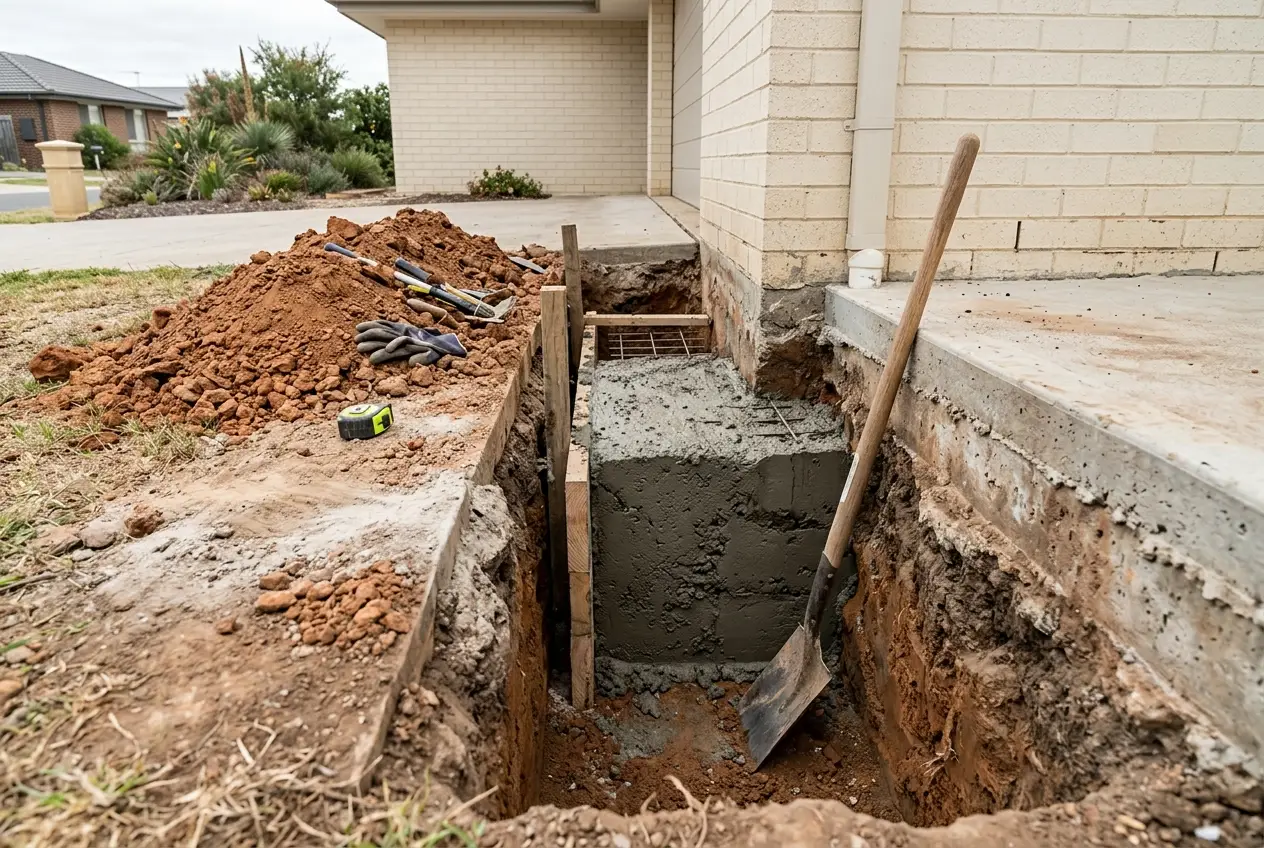
Cranbourne housing — what we are usually dealing with
Cranbourne grew hard from the 1990s onward and has kept growing, spreading into Cranbourne North, West and East, so the stock spans thirty years of estate construction — brick veneer on waffle-pod and stiffened raft slabs, single and double storey. The older estates are now mature enough to be showing cumulative movement. The newest are young enough that a defect is often still within statutory warranty. Because the suburb expanded in several directions across genuinely different ground, the age of the house tells you less here than in most growth suburbs; where it sits matters more.
The ground under Cranbourne
This is what makes Cranbourne distinct. The eastern side sits on sandier material — free-draining, low-reactivity, but prone to washout where water escapes from a pipe. To the west and south the ground becomes heavier clay with reactive behaviour and site classifications commonly reaching H1 or H2. Across the lower-lying ground on the old Carrum Carrum swamp margins there are soft, compressible and in places organic soils, where the issue is consolidation settlement under load rather than seasonal swelling at all. Three different mechanisms in one postcode, needing three different responses.
What this means for your job
Because of that variability, the site classification and soil report matter more in Cranbourne than almost anywhere else we work, and we will always ask whether you have the original one from the build. A house settling into soft low-lying ground needs piers taken down to competent material and will not be helped by treating it as a reactive-clay problem. A house on the sandy eastern side showing localised, accelerating settlement is a washout until proven otherwise, and the first call should be a drain camera rather than an engineer. Getting the mechanism right is most of the value of the assessment.
What we see in Cranbourne homes
- Localised settlement that has accelerated over one or two years — points to washout
- Slow, steady, one-way settlement across a whole side of the house — points to soft ground consolidation
- Cracking that opens in summer and partly closes in winter — points to reactive clay
- Persistently damp or greener ground on one side of the house through a dry spell
Underpinning costs in Cranbourne
$16,000 – $36,000 for a typical underpinning jobPriced per pier at $1,500 to $3,500 each, commonly eight to fifteen piers. The range is wide in Cranbourne because depth to competent ground varies so much: a pier on firm material at 2 metres and a pier taken through soft low-lying soil to 5 metres are very different prices. On the soft ground in the lower-lying areas, screw piles are often the more economical option because they can be driven to refusal rather than excavated.
Indicative range only, based on typical jobs in this area. Access, soil conditions and the extent of movement change the number — a fixed price follows an on-site inspection.
The right service for Cranbourne
Cranbourne is a slab-on-ground suburb, so there are no stumps to replace here — the service that applies is underpinning and foundation repair. Anyone offering you "restumping in Cranbourne" has not looked at what your house is built on. See how we assess slab movement, and how heave differs from settlement, on our underpinning page.
Underpinning in Cranbourne — your questions
Why does the ground vary so much across Cranbourne?
Because the suburb expanded across genuinely different geology rather than out from a single centre. The eastern side carries sandier material, the western and southern areas are heavier reactive clay, and the lower-lying ground toward the old swamp margins holds soft, compressible and sometimes organic soils. Those three behave in completely different ways under a house — washout, seasonal swelling, and long-term consolidation respectively. It is why the original soil report and site classification for your specific address is more useful in Cranbourne than any general statement about the suburb, and why we ask for it first.
My house is settling slowly and evenly — is that reactive clay?
Probably not. Reactive clay movement is seasonal and reverses: cracks open through a dry summer and partly close through winter. Slow, steady, one-way settlement that never recovers is the signature of consolidation — the ground beneath compressing under the weight of the house — and it is what we see on the softer low-lying ground here. That distinction changes the repair completely, because consolidation is addressed by transferring the load down to competent material through piers, while seasonal clay movement is often addressed by managing moisture and stiffening the affected edge.
My Cranbourne home is only six years old — do I have any recourse?
Quite possibly. Victorian domestic building work carries a statutory warranty of ten years for structural defects, and inadequate footing design for the actual site conditions can fall within that. On variable Cranbourne ground, the question is often whether the site classification used at design was appropriate for what was actually there. Get a floor level survey, get an independent engineer's report, keep dated photographs, and raise it formally with the builder in writing rather than waiting. Documented early, these matters go considerably better than documented at year nine.
We also work near Cranbourne
Worth reading next: Reactive clay in Melbourne's west, explained