Wyndham · Werribee 3030
Underpinning & foundation repair in Werribee
Werribee is the Wyndham suburb where housing age actually varies, and that changes the diagnosis. An established 1970s brick-veneer home near the town centre and a 2015 estate home out towards Wyndham Vale sit on similar clay but fail in quite different ways — and mature trees are far more often the culprit in the older streets.
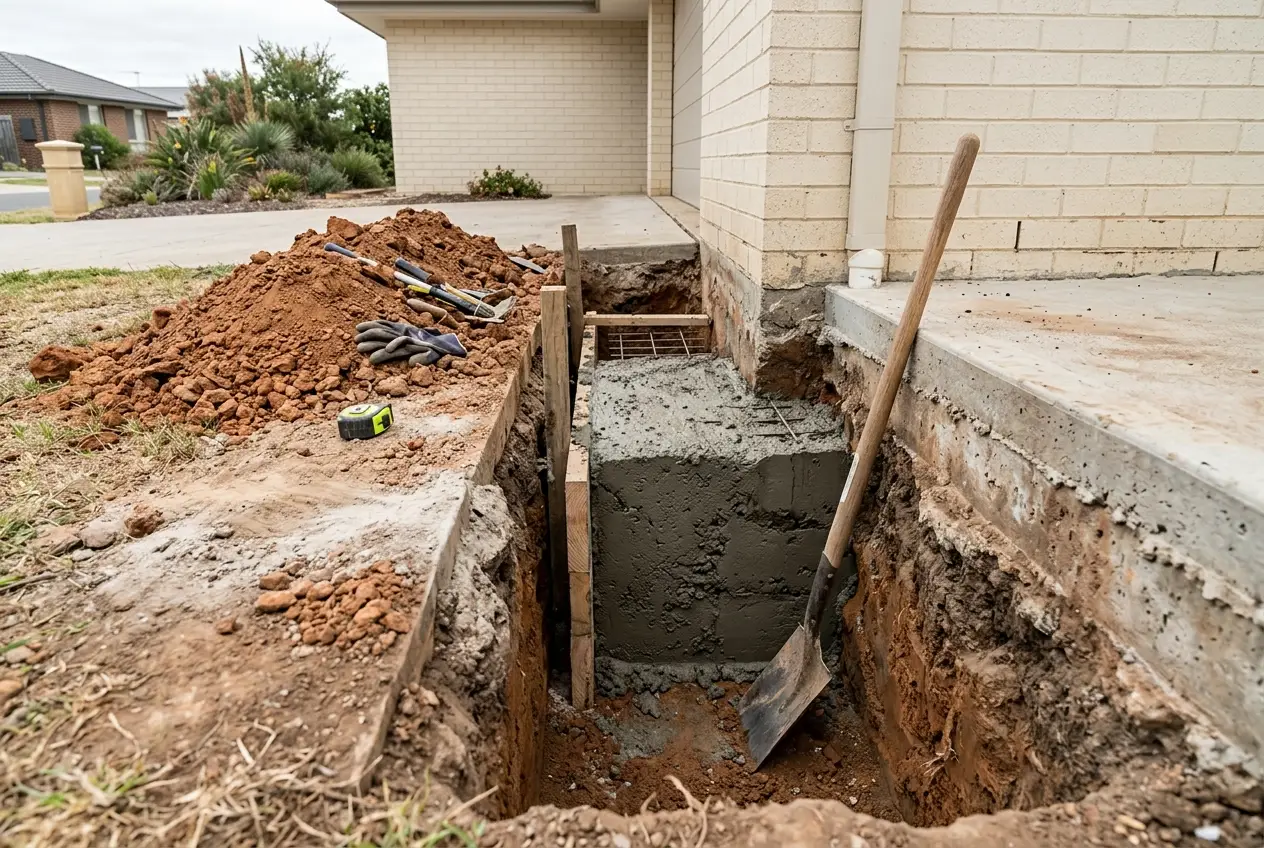
Werribee housing — what we are usually dealing with
Unlike the newer corridor suburbs around it, Werribee has genuine layers: a core of 1960s to 1980s brick veneer and some earlier housing around the town centre and Watton Street, then successive waves of estate development out towards Wyndham Vale and Manor Lakes. The older brick-veneer stock was built with shallower strip footings than a reactive site would be given today, and it now has forty to sixty years of seasonal clay movement behind it. Some of the oldest homes closer to the centre do have suspended timber floors on stumps — Werribee is the one Bucket B suburb where restumping occasionally is the right answer, which is exactly why a physical inspection beats an assumption.
The ground under Werribee
Werribee sits on the Werribee plains — reactive clay soils, moderately to highly reactive depending on where you are in the suburb, with alluvial influence closer to the Werribee River. The plain is flat, so drainage falls are shallow and surface water moves away slowly. The combination of reactive clay and slow drainage means moisture sits around footings longer than it should after heavy rain.
What this means for your job
Trees are the distinguishing factor in Werribee's older streets. Forty years of growth means large established trees — in gardens, on nature strips, and along the river corridor — with root systems drawing significant moisture out of reactive clay through summer. That produces classic one-sided subsidence: the corner of the house nearest the tree drops relative to the rest, and it worsens sharply in drought years. It is a genuinely different problem from the fill settlement out at Tarneit or the estate drainage faults at Caroline Springs, and the fix has to reflect it — piers founded below the root influence zone, and sometimes a root barrier as part of the works.
What we see in Werribee homes
- Movement concentrated at the corner or side of the house closest to a large established tree
- Cracking that worsened noticeably through drought years and never recovered
- Diagonal cracks in older brick veneer running from window corners toward the eaves
- A veranda, porch or garage slab pulling away from the main house
- In older Werribee homes, sloping timber floors — which may point to stumps rather than footings
Underpinning costs in Werribee
$14,000 – $30,000 for typical underpinningPiers commonly run $1,500 to $2,800 each in Werribee, with older shallow-footed homes often needing fewer piers than a full-perimeter job because movement is localised to one tree-affected side. Where a tree is the cause, allow for a root barrier or arborist involvement as part of the scope.
Indicative range only, based on typical jobs in this area. Access, soil conditions and the extent of movement change the number — a fixed price follows an on-site inspection.
The right service for Werribee
Werribee is a slab-on-ground suburb, so there are no stumps to replace here — the service that applies is underpinning and foundation repair. Anyone offering you "restumping in Werribee" has not looked at what your house is built on. See how we assess slab movement, and how heave differs from settlement, on our underpinning page.
Underpinning in Werribee — your questions
Can the tree in my Werribee yard really crack my house?
On reactive clay, yes, and it is one of the most common causes we find in the older parts of Werribee. A mature tree can draw very large volumes of moisture out of the soil through summer. On clay that shrinks as it dries, that produces a localised drop in ground level on the side of the house nearest the tree, and the footings go down with it. The signature is one-sided movement that gets dramatically worse in drought years. Removing the tree is not always the answer — the clay can then rehydrate and heave the ground back up, which causes its own damage — so the sequence needs to be planned rather than improvised.
My Werribee home is from the 1970s — are its footings the problem?
Often, in the sense that they are shallower than a reactive site would receive today. AS 2870, which governs residential slab and footing design on reactive soils, and the site classification system that goes with it were not applied with anything like today's rigour when much of Werribee's older stock was built. Those footings are frequently founded in the upper zone of clay where seasonal moisture change is strongest. Underpinning works precisely because it transfers the load to a depth below that zone — which is why properly founded piers stop movement that shallow footings never could.
Does any home in Werribee actually need restumping?
Some do, and Werribee is the one suburb in Melbourne's west where the question is genuinely worth asking. The older housing closer to the town centre includes homes with suspended timber floors on stumps, which do need restumping if those stumps have failed. The newer estate housing out towards Wyndham Vale and Manor Lakes is slab-on-ground and cannot be restumped at all. This is exactly why the service should follow an inspection rather than a suburb name — the assumption goes wrong in both directions here.
We also work near Werribee
Worth reading next: Reactive clay in Melbourne's west, explained