West · Deer Park 3023
Underpinning & foundation repair in Deer Park
Deer Park spans fifty years of housing on the same difficult ground, and the era of your house changes the diagnosis completely. A 1975 brick veneer near the station and a 2015 estate home off Robinsons Road sit on identical basalt clay and crack for quite different reasons — one from footings that predate modern reactive-site design, the other from drainage and fill.
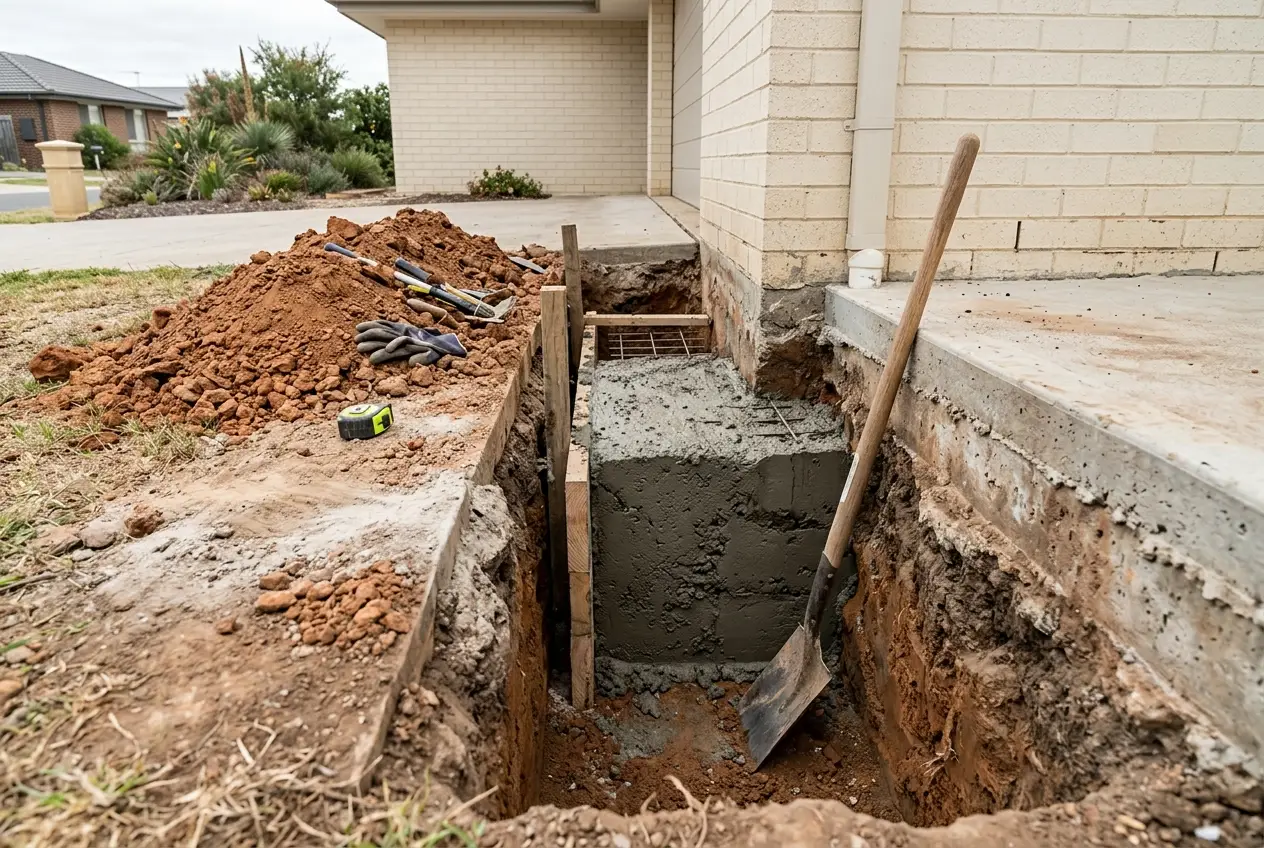
Deer Park housing — what we are usually dealing with
Deer Park has genuine layers, which is unusual out here. There is a substantial body of 1970s and 1980s single-storey brick veneer through the established streets, built when reactive-site footing design was applied far less rigorously than it is today. Around and beyond it are newer estates from the 2000s and 2010s built to current AS 2870 standards. In the older stock we find genuine footing inadequacy — footings founded in the top zone of clay where seasonal movement is strongest, now with forty-plus years of cycling behind them. In the newer stock the slab is almost always compliant and the problem is what water is doing around it.
The ground under Deer Park
Deer Park sits squarely on the Newer Volcanics basalt plain, and the residual clay is among the more reactive in metropolitan Melbourne — the same ground that runs through Sunshine, Cairnlea and out to Caroline Springs. The area also carries an industrial and quarrying history, which means pockets of imported or disturbed fill in places you would not expect, particularly on lots near former quarry and works sites. Where fill is present and poorly documented, it is worth establishing its depth before designing any pier solution.
What this means for your job
The first question in Deer Park is always the build year, because it sends the job down one of two paths. Pre-1990 brick veneer: expect shallow strip footings, movement that has accumulated over decades, and underpinning that is genuinely warranted where displacement is progressive. Post-2000 slab: expect a compliant slab and look hard at downpipes, under-slab plumbing and garden watering before anyone talks about piers. Getting that sequencing right is the difference between a $4,000 drainage correction and a $30,000 underpin, and plenty of people are sold the second when they needed the first.
What we see in Deer Park homes
- Stair-step cracking through mortar joints in older brick veneer
- Cracking that has recurred in the same place after being patched years ago
- In newer homes, cracking concentrated near a downpipe or a wet area
- A garage or carport slab separating from the main house
- Doors binding in one section of the house but not the rest
Underpinning costs in Deer Park
$13,000 – $30,000 for typical underpinningPiers commonly run $1,600 to $2,900 each. Older shallow-footed homes often need fewer piers because movement is localised, while newer homes on undocumented fill can need deeper and therefore dearer ones. Establish the build year and the fill history before accepting any per-pier quote.
Indicative range only, based on typical jobs in this area. Access, soil conditions and the extent of movement change the number — a fixed price follows an on-site inspection.
The right service for Deer Park
Deer Park is a slab-on-ground suburb, so there are no stumps to replace here — the service that applies is underpinning and foundation repair. Anyone offering you "restumping in Deer Park" has not looked at what your house is built on. See how we assess slab movement, and how heave differs from settlement, on our underpinning page.
Underpinning in Deer Park — your questions
Does the age of my Deer Park house change the repair?
Substantially. Homes built before about 1990 typically have shallow strip footings founded in the upper zone of clay, where seasonal moisture change is strongest — after forty years of wetting and drying, genuine progressive displacement is common and underpinning is often the correct answer. Homes built from the 2000s onward have slabs engineered under AS 2870 to tolerate that movement, so when they crack the cause is usually an external moisture source rather than the footing itself. Same soil, same suburb, two different investigations.
Deer Park has old quarry and industrial land — does that affect my foundation?
It can, and it is worth establishing rather than assuming. Parts of the area carry a quarrying and industrial history, which means some lots contain imported or disturbed fill of varying depth and compaction. A slab spanning natural ground on one side and deep fill on the other will settle unevenly regardless of how well the house was built. If your title or soil report indicates fill, any pier design has to reach competent natural ground beneath it — piers founded within fill move with the fill.
Is it restumping or underpinning I need in Deer Park?
Almost certainly underpinning. Deer Park's housing is brick veneer on concrete slab or shallow strip footings across every era present in the suburb — there are no suspended timber floors on stumps in the estate housing, and very few in the older stock. Restumping is a service for pre-1970s timber-floored homes, which is a different construction era concentrated in the inner west and inner north.
We also work near Deer Park
Worth reading next: Reactive clay in Melbourne's west, explained