Service · Slab homes on reactive clay
Underpinning & foundation repair in Melbourne
Brick-veneer home on a concrete slab, cracks climbing the walls, doors that bind in summer and free up in winter? That is the ground moving, not the house failing — and it is the normal condition across Melbourne's western growth corridor.
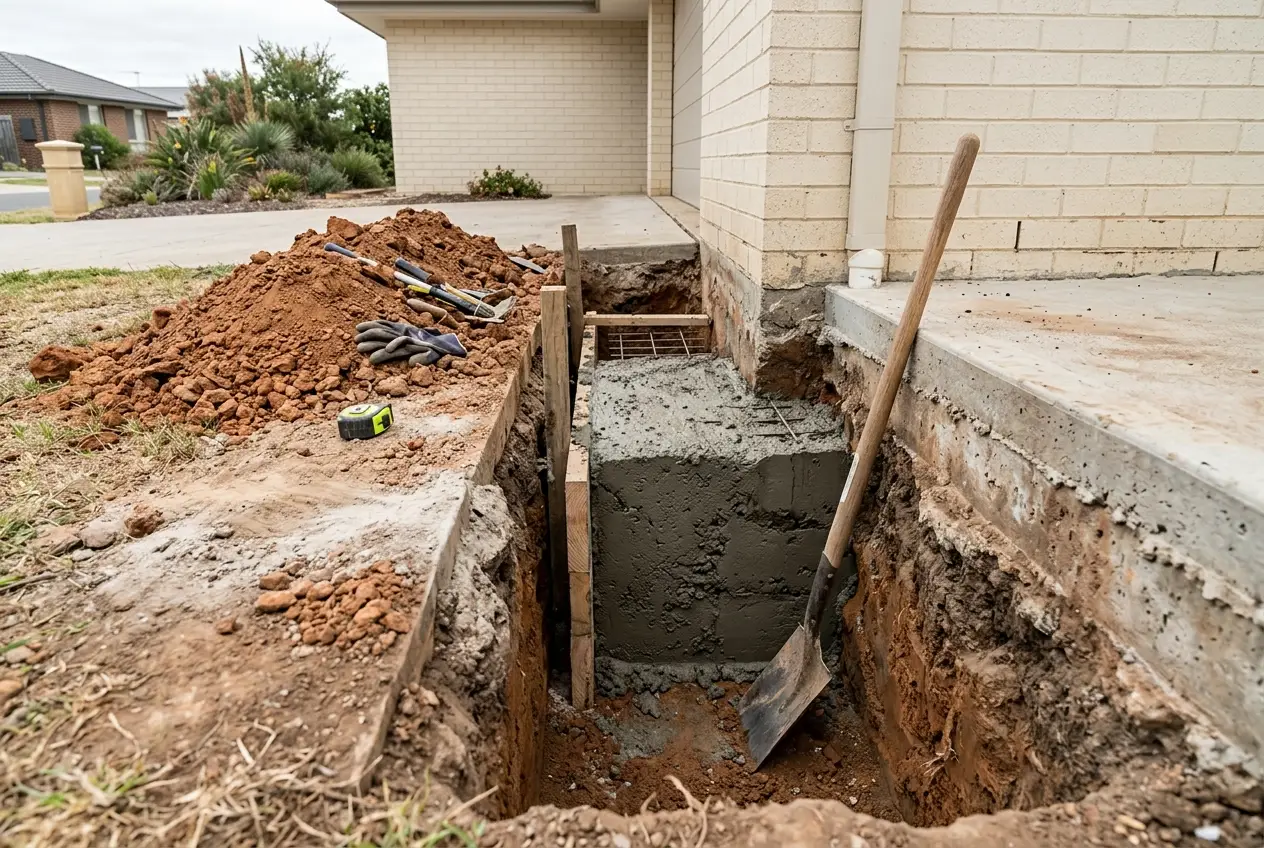
Why slab homes crack on Melbourne's western clay
The plains running west from Sunshine through Caroline Springs, Melton and out across Wyndham sit on basalt-derived clay with a high shrink-swell capacity. Wet it and it expands; dry it out and it contracts. Over a single year the ground surface rises and falls measurably, and site classifications through these estates commonly come back as H1 or H2 — "highly reactive" — underAS 2870.
A compliant slab is engineered to tolerate that movement, not to stop it. Trouble starts when the moisture balance under one part of the slab differs from the rest, so one section lifts or drops relative to its neighbour. The usual culprits are entirely mundane:
- A downpipe discharging at the slab edge rather than into stormwater.
- A cracked or leaking sewer or water line running under the slab.
- Garden beds watered daily hard against the house, on one side only.
- A large tree drawing moisture out of the clay on one side through summer.
- Paving or landscaping that has settled and now falls back towards the house.
- Deep engineered fill under part of the lot that is still consolidating.
Heave or settlement? The direction changes the fix
Slab heave is soil swelling and pushing part of the slab up — typically the perimeter lifting relative to the centre, which shows as cracking above window and door heads and doors binding at the top. Settlement is the opposite: support is lost beneath a section and it drops, often near a leaking pipe or over poorly compacted fill. Both produce diagonal brickwork cracks and both feel like "the house is sinking". Underpinning addresses settlement. Heave frequently needs the moisture source corrected and a period of monitoring first — piers installed against a heaving slab can make matters worse.
How we assess it
- Floor level survey. Levels are taken across the whole floor plate so the shape of the movement — and its direction — is measured, not eyeballed.
- Crack mapping. Location, width, direction and taper of every significant crack, recorded so it can be compared later.
- Drainage and plumbing check. Where the stormwater goes, and whether a CCTV drain inspection or static water test is warranted.
- Site and soil history. Original soil report, site classification and fill records where the home is in a corridor estate.
- Monitoring, where it is honest to do so. If movement looks seasonal, measuring across a wet and a dry season beats committing $30,000 on one visit.
- Engineered repair design. Where piers are warranted, an engineer specifies depth and spacing and the permit is issued against that design.
What underpinning costs in Melbourne
$15,000 – $40,000 for typical underpinningPriced per pier at roughly $1,500 to $3,500 each, with most jobs needing eight to fifteen along the affected section. Deep-fill and drought-prone sites such as Melton and Tarneit need longer piers and sit at the top. Resin injection for early, localised movement runs $5,000 to $15,000; crack repair with articulation joints starts near $3,000.
Indicative range only, based on typical jobs in this area. Access, soil conditions and the extent of movement change the number — a fixed price follows an on-site inspection.
Underpinning suburbs
These are the slab-on-ground suburbs where underpinning — not restumping — is the service that applies. Each page covers the local soil, the specific failure pattern we see there, and a cost band:
- Underpinning Caroline SpringsWestern Growth Corridor · $15,000 – $35,000 for typical underpinning
- Underpinning MeltonWestern Growth Corridor · $18,000 – $40,000 for typical underpinning
- Underpinning Point CookWyndham · $15,000 – $32,000 for typical underpinning
- Underpinning TarneitWyndham · $16,000 – $38,000 for typical underpinning
- Underpinning WerribeeWyndham · $14,000 – $30,000 for typical underpinning
- Underpinning Hoppers CrossingWyndham · $12,000 – $28,000 for typical underpinning
- Underpinning TruganinaWyndham · $16,000 – $38,000 for typical underpinning
- Underpinning Taylors HillWestern Growth Corridor · $15,000 – $34,000 for typical underpinning
- Underpinning Deer ParkWest · $13,000 – $30,000 for typical underpinning
- Underpinning Wyndham ValeWyndham · $14,000 – $31,000 for typical underpinning
- Underpinning CairnleaWest · $16,000 – $34,000 for typical underpinning
- Underpinning Williams LandingWyndham · $15,000 – $32,000 for typical underpinning
- Underpinning Glen WaverleyEastern Suburbs · $18,000 – $38,000 for a typical underpinning job
- Underpinning BerwickSouth-East Growth Corridor · $18,000 – $40,000 for a typical underpinning job
- Underpinning Narre WarrenSouth-East Growth Corridor · $16,000 – $34,000 for a typical underpinning job
- Underpinning CranbourneSouth-East Growth Corridor · $16,000 – $36,000 for a typical underpinning job
- Underpinning Clyde NorthSouth-East Growth Corridor · $18,000 – $42,000 for a typical underpinning job
- Underpinning PakenhamSouth-East Growth Corridor · $16,000 – $34,000 for a typical underpinning job
If your home has a timber floor on stumps instead of a slab, you wantrestumping — a different job entirely.
Underpinning questions, answered properly
What is underpinning?
Underpinning transfers the weight of a building from footings that are sitting in unstable or moving ground down to a depth where the ground is stable. In Melbourne that usually means concrete piers or screw piles installed beneath the existing footing or slab edge, taken below the zone where seasonal moisture changes make reactive clay swell and shrink. The house then bears on the piers instead of on soil that moves.
What is slab heave?
Slab heave is the opposite of the settlement most people assume is happening. Reactive clay under part of a slab absorbs water, swells, and pushes that section of slab upward relative to the rest. It is extremely common in Melbourne's western growth corridor and is usually driven by a moisture source: a downpipe discharging at the slab edge, a leaking under-slab pipe, or heavy garden watering against the house. Heave lifts, settlement drops, and the repair differs — so identifying the direction is the first job.
What does underpinning cost in Melbourne?
Underpinning is priced per pier, typically $1,500 to $3,500 each depending on depth and access, and most jobs need eight to fifteen piers along the affected section — so $15,000 to $40,000 is the usual range. Deeper piers, which are common in Melton and through the deep-fill estates, sit at the top. Resin injection for minor slab movement runs $5,000 to $15,000, and crack repair with articulation joints starts around $3,000.
Resin injection or traditional underpinning?
They solve different severities. Resin injection pumps an expanding structural polymer into the soil under the slab to fill voids and lift it back — fast, minimally invasive, no excavation, and well suited to localised settlement caught early. Traditional concrete underpinning excavates and builds new piers to competent ground; it is more disruptive and more expensive, but it is what genuine structural movement on deep reactive clay requires. A resin fix on a problem that needed piers is money wasted, so the assessment matters more than the method.
Which cracks actually matter?
Direction and behaviour tell you more than width. Diagonal or stair-step cracks following mortar joints and running from the corners of windows and doors indicate structural movement. Cracks that are wider at one end than the other, cracks you can see daylight through, and cracks that keep widening month after month are the ones to act on. Fine vertical cracks in plaster that stay the same size, and cracks that open every summer and close every winter, generally indicate seasonal movement rather than failure. Mark and date each crack end with a pencil, then check in three months — that record is worth more to an engineer than any single photo.
Do I need an engineer before underpinning?
For any genuine underpinning job, yes — and get one who is independent of whoever will do the work. A structural or geotechnical engineer establishes the cause, the direction of movement and the required pier depth, and produces the design a building permit is issued against. It also matters commercially: if the movement stems from a construction defect within the six-year domestic building insurance window, or from a burst pipe your insurer may cover, an independent report is what makes that claim possible. Repairs destroy the evidence, so the report comes first.
Related reading:Underpinning methods compared ·Reactive clay in Melbourne's west, explained ·What underpinning costs in Melbourne ·Can a leaking pipe make a house sink? ·Slab lifting & concrete levelling ·Restumping & reblocking