Service · Method comparison
Underpinning methods compared
Four methods dominate residential underpinning in Melbourne, and they are not competitors so much as different tools. The useful question is never which is best — it is which one matches the depth to competent ground, the soil in between, the access, and the load. A contractor who names a method before seeing the site is describing their equipment.
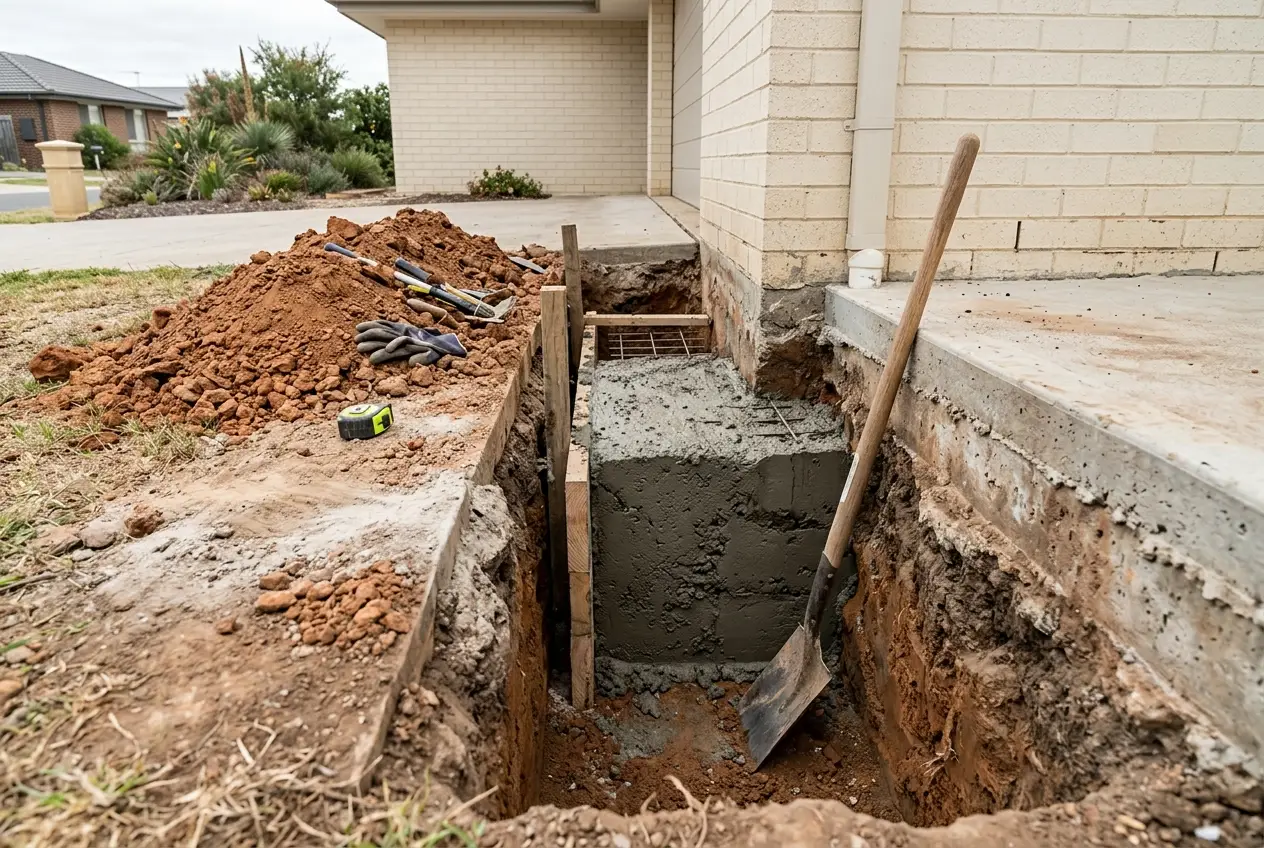
1. Mass concrete underpinning
The oldest method and conceptually the simplest. Short sections beneath the existing footing are excavated in a carefully staggered sequence — never adjacent bays at once — and each is filled with mass concrete, extending the footing down to competent ground.
- Suits: shallow competent ground, typically under 2 metres; older strip footings; sites where machine access is possible.
- Strengths: no specialist plant, very well understood, high load capacity, easy to verify visually.
- Limitations: slow, large volumes of excavation and spoil, sequencing is critical and the work is genuinely dependent on the crew's discipline. Impractical where competent ground is deep.
- Indicative: $1,200 – $2,500 per bay.
2. Bored concrete piers
Holes are augered down to competent ground beside or beneath the footing, reinforced and filled with concrete, and the structure's load is transferred onto them with needle beams or brackets. This is the workhorse method for Melbourne residential underpinning.
- Suits: most Melbourne conditions where competent ground sits between roughly 2 and 5 metres; reactive clay sites where the pier must reach below the zone of seasonal moisture change.
- Strengths: high capacity, well suited to clay, far less excavation than mass concrete, widely available and competitively priced.
- Limitations: needs auger access, generates spoil, requires curing before load transfer, and can be difficult in collapsing or waterlogged ground.
- Indicative: $1,500 – $3,500 per pier.
3. Screw piles
Steel shafts with helical plates are hydraulically screwed into the ground until they reach a specified torque, which corresponds to a known load capacity. The structure is then bracketed onto them.
- Suits: deep, variable or soft ground where the depth to competent material is unknown or inconsistent; tight access; jobs that need to be finished quickly.
- Strengths: installed to refusal rather than to an assumed depth, so they find competent ground wherever it is; minimal spoil; no curing time, so load can be transferred immediately; small plant fits where an auger will not.
- Limitations: higher cost per pile; needs specialist equipment and an operator who understands torque correlation; can be obstructed by rock or buried obstructions.
- Indicative: $2,000 – $4,000 per pile.
4. Polyurethane resin injection
Expanding structural resin is injected through small holes beneath a slab. It fills voids, densifies loose soil and, at sufficient pressure, lifts the slab. It is a soil treatment rather than a load-transfer system, and that distinction is the whole story.
- Suits: structurally sound slabs sitting over voids or loose, poorly compacted soil; situations where disruption must be minimal; slabs needing re-levelling rather than support.
- Strengths: fast — often a day; no excavation; the house stays occupied and usable; markedly cheaper than piers.
- Limitations: does not transfer load to competent ground, so it cannot compensate for an inadequate footing or deep-seated movement. Useless if the leak or drainage failure that caused the void is not fixed first.
- Indicative: $5,000 – $15,000 for a residential slab.
The full comparison against piers is set out inresin injection vs underpinning.
How the method actually gets chosen
- Geotechnical investigation. What is the soil, and how deep is competent ground? This one answer eliminates two of the four methods on most sites.
- Floor level survey and crack mapping. Which way has the house moved, how much, and is it still moving?
- Drainage assessment. If a leak or a downpipe caused it, that is fixed first regardless of method — otherwise you are engineering against a moving target.
- Access assessment. What plant can physically reach each pier location? This routinely decides between bored piers and screw piles.
- Engineering design. Pier type, count, depth, spacing and load transfer detail, documented for the building permit.
Quick comparison
| Method | Typical depth | Indicative cost | Best for |
|---|---|---|---|
| Mass concrete | Under 2 m | $1,200–$2,500 / bay | Shallow competent ground, old strip footings |
| Bored piers | 2–5 m | $1,500–$3,500 / pier | Most Melbourne clay sites |
| Screw piles | Variable, to refusal | $2,000–$4,000 / pile | Deep, soft or variable ground; tight access |
| Resin injection | Under slab | $5,000–$15,000 / job | Sound slab over voids or loose soil |
All figures are indicative ranges. Depth is the dominant variable in every one of them, which is why a geotechnical report before you compare quotes is money well spent — seewhat underpinning costs in Melbourne.
Underpinning method questions, answered properly
Which underpinning method is best?
There is no best method in the abstract, and any contractor who names one before seeing your site is telling you which equipment they own rather than what your house needs. The choice is driven by four things: the depth to competent ground, the soil type between here and there, the access available, and the load the structure imposes. Deep reactive clay with tight access points toward screw piles. Shallow competent ground with good access points toward mass concrete or bored piers. Voids under a sound slab point toward resin. The right question is not which method is best but which one matches your site.
Are screw piles better than concrete piers?
They are better in specific conditions and more expensive in others. Screw piles are driven until they meet resistance, so they find competent ground at whatever depth it actually occurs rather than requiring you to excavate to it — which makes them well suited to deep, variable or soft ground. They are fast, they generate almost no spoil, and they work in tight access. Bored concrete piers are usually the better economics where competent ground is reasonably shallow and predictable, and they carry very high loads well. It is a site decision, and the geotechnical information is what settles it.
How deep does underpinning need to go?
Deep enough to reach ground that does not move seasonally and can carry the load — which in Melbourne varies enormously. On shallow competent ground it can be 1.5 to 2 metres. On the reactive clay of the western and south-eastern growth corridors, piers commonly go 3 to 4.5 metres to get below the zone of seasonal moisture change. On soft low-lying ground it can be deeper still. Depth is the single largest cost variable in underpinning, which is why a geotechnical report that establishes it is worth commissioning before you compare quotes rather than after.
Does underpinning lift the house back to level?
Sometimes, partly, and it should be a deliberate decision rather than a surprise. Underpinning can be designed either to stabilise the structure where it currently sits, or to jack it back toward its original level as the load is transferred. Re-levelling is more expensive, takes longer, and carries a real risk of additional cracking as a distorted structure is moved — a house that has settled into a shape over fifteen years does not enjoy being straightened. On a heavily distorted house, partial recovery is often the sensible target rather than perfect level. Establish which you are buying before signing.
How long does underpinning take?
One to three weeks on site for a typical residential job, depending on pier count, depth and method — screw piles are the fastest, mass concrete the slowest because it is excavated and poured in sequence. Add curing time before the load is transferred on concrete methods. Before any of that, allow two to four weeks for the geotechnical report, engineering design and building permit. Most homeowners stay in the house throughout, since the work happens outside and underneath.
Is underpinning permanent?
The piers are. A properly designed pier founded on competent ground will carry its load indefinitely. What is not automatically permanent is the outcome, for two reasons. If the moisture problem that caused the movement is left in place, the parts of the house that were not underpinned continue to move, and a new differential opens up between the stabilised section and the rest. And underpinning designed for the wrong depth — stopping within the zone of seasonal soil movement rather than below it — will move with the ground exactly as the original footing did. Design and drainage are what make it permanent, not the concrete.
Related:Underpinning & foundation repair ·What underpinning costs ·AS 2870 soil classes decoded