Western Growth Corridor · Taylors Hill 3037
Underpinning & foundation repair in Taylors Hill
Taylors Hill is at the age where the trees start causing the problems. The estates went in from the late 1990s, which means the landscaping planted at construction is now twenty-five years old with root systems to match — and on reactive basalt clay, a mature tree beside the house is one of the most effective ways to dry out and shrink the ground under a slab.
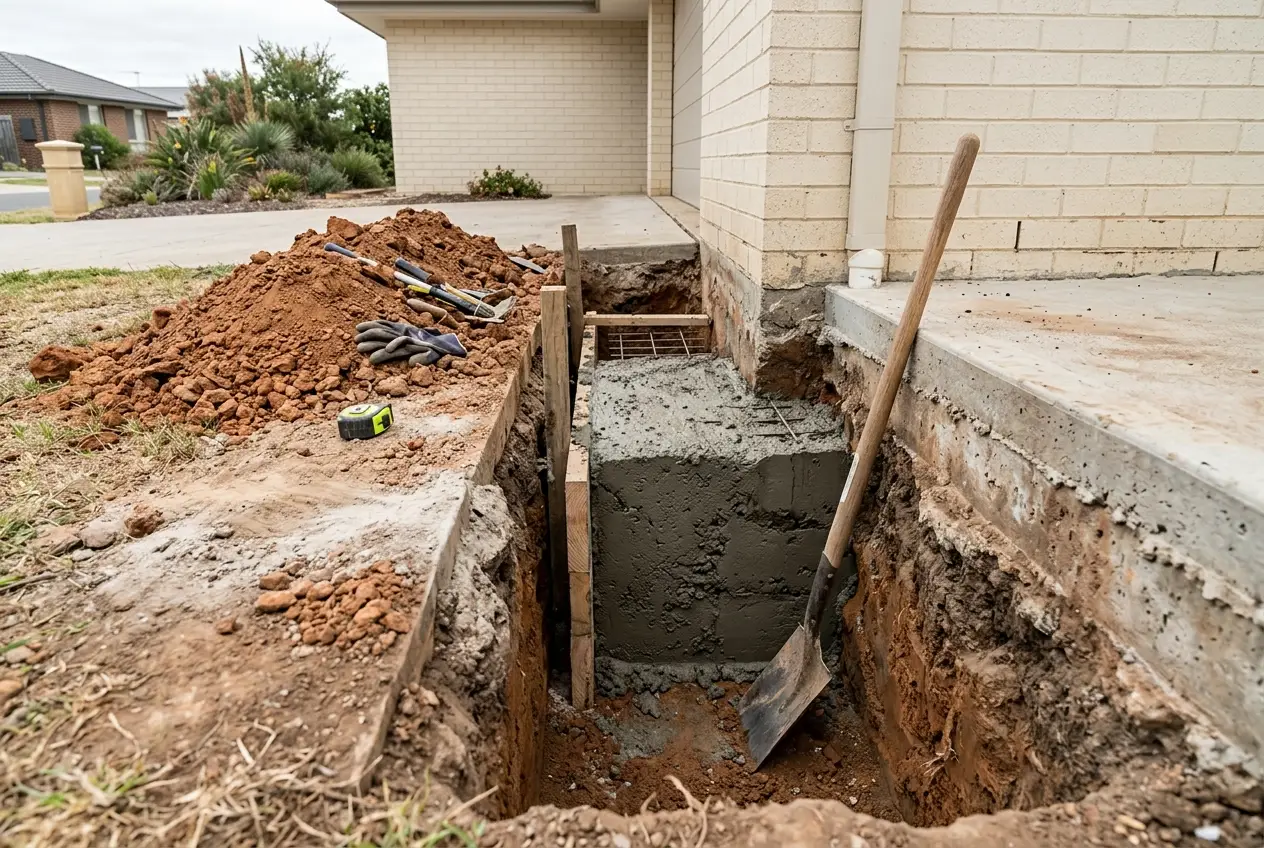
Taylors Hill housing — what we are usually dealing with
Taylors Hill filled in from roughly 1997 through the 2000s, brick veneer on slab-on-ground built under AS 2870, on generally larger and more elevated lots than the flat estates further south. The housing itself is sound and was built to modern standards. What has changed is everything around it: gardens established, street trees matured, paving and driveways settled, drainage modified by two decades of owners adding decks, pergolas and extensions. Almost every foundation problem we assess in Taylors Hill traces back to one of those later changes rather than to the original construction.
The ground under Taylors Hill
This is basalt-derived clay from the Newer Volcanics plains, moderately to highly reactive, and Taylors Hill sits on some of the more elevated ground in the corridor. Elevation matters in a specific way here: better natural drainage means the soil dries out more thoroughly through summer than it does on the flat, poorly drained ground at Werribee or Point Cook. Deeper summer drying means a bigger annual shrink-swell range, and a bigger range is harder for a shallow-founded slab edge to tolerate.
What this means for your job
The practical Taylors Hill conversation is almost always about a tree. A mature eucalypt, liquidambar or similar within striking distance of the slab can draw very large volumes of moisture out of clay through summer, shrinking the ground on that side and dropping the footings with it. The signature is one-sided movement that worsens sharply in drought years. Removing the tree is not automatically the fix — the clay then rehydrates and can heave the ground back up, causing fresh damage in the opposite direction. The right sequence is to establish the tree's influence first, then decide between root barriers, staged removal, or piers founded below the root zone.
What we see in Taylors Hill homes
- Movement concentrated on the side of the house nearest a large established tree
- Cracking that got dramatically worse through drought years and never recovered
- A pergola, deck or extension added years after construction now separating from the house
- Paving or driveway that has settled and now falls back toward the slab
- Cracking above windows and doors on one elevation only
Underpinning costs in Taylors Hill
$15,000 – $34,000 for typical underpinningPiers typically run $1,800 to $3,200 each. Where a tree is driving the movement, budget for an arborist assessment and possibly a root barrier as part of the scope — treating the piers as the whole solution while the tree keeps drying the clay is how people end up doing this twice.
Indicative range only, based on typical jobs in this area. Access, soil conditions and the extent of movement change the number — a fixed price follows an on-site inspection.
The right service for Taylors Hill
Taylors Hill is a slab-on-ground suburb, so there are no stumps to replace here — the service that applies is underpinning and foundation repair. Anyone offering you "restumping in Taylors Hill" has not looked at what your house is built on. See how we assess slab movement, and how heave differs from settlement, on our underpinning page.
Underpinning in Taylors Hill — your questions
Can a tree really crack my Taylors Hill house?
On reactive basalt clay, yes, and it is the most common cause we find here. A mature tree can draw hundreds of litres of water a day out of the soil in summer. On clay that shrinks as it dries, that produces a localised drop in ground level on the side of the house nearest the tree, and shallow footings go down with it. The signature is one-sided movement that worsens markedly in drought years and never fully recovers in wet ones. It is a genuinely different problem from the drainage faults we see in newer estates, and the fix has to address the moisture demand, not just the symptom.
Should I remove the tree to fix the cracking?
Not without planning it properly, and sometimes not at all. Removing a mature tree from reactive clay lets the soil rehydrate and swell back, which can heave the ground under that part of the house and cause a fresh round of damage in the opposite direction — occasionally worse than what the tree was doing. It may also be protected under your council's local law. The considered approach is to establish how much of the movement the tree is actually responsible for, then choose between a root barrier, staged removal with monitoring, or underpinning founded below the root influence zone.
My Taylors Hill home is 25 years old — is the slab failing?
Very unlikely. A slab built to AS 2870 on a reactive site is engineered to tolerate substantial seasonal ground movement, and twenty-five years is not old for concrete. What has changed in that time is the environment around the slab: trees matured, gardens established, drainage altered by later decks and extensions, paving settled. In Taylors Hill the slab is almost never the defect — the moisture balance around it is what changed, and that is usually what needs correcting.
We also work near Taylors Hill
Worth reading next: Reactive clay in Melbourne's west, explained