Western Growth Corridor · Caroline Springs 3023
Underpinning & foundation repair in Caroline Springs
Search for foundation work in Caroline Springs and you will mostly find restumping pages. That is the wrong service for this suburb. Caroline Springs was built from 1999 onwards on slab-on-ground foundations over highly reactive basalt clay — there are no stumps to replace. What these homes need is underpinning, slab-heave assessment and structural crack repair.
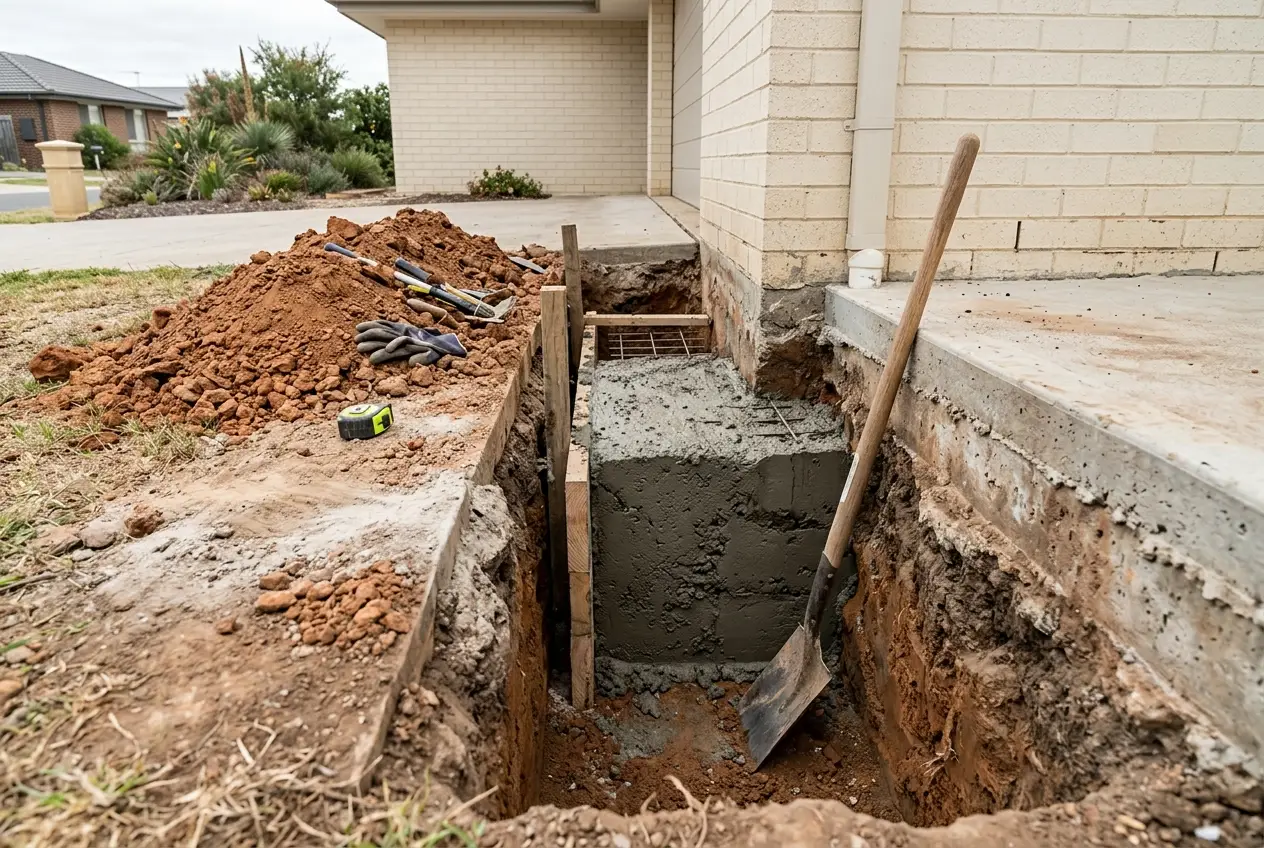
Caroline Springs housing — what we are usually dealing with
Caroline Springs is a master-planned estate suburb: the first homes went up around 1999 and the bulk of the housing dates from 2000 to 2012. Almost all of it is brick veneer on a waffle-pod or stiffened raft slab, built under AS 2870. That matters because the earliest estates are now 25 years old, which is exactly the age where cumulative seasonal clay movement, matured landscaping and two decades of drainage neglect start showing up as cracking. The homes are not old — the ground under them has simply been through 25 cycles of swelling and shrinking.
The ground under Caroline Springs
The whole area sits on the Newer Volcanics basalt plain, and the residual clay it weathers into is among the more reactive soils in metropolitan Melbourne. Site classifications through these estates are commonly H1 or H2 under AS 2870 — 'highly reactive', meaning the standard anticipates substantial surface movement. A compliant slab is designed to tolerate that movement, not to prevent it. When something changes the moisture balance under one part of the slab — a leaking stormwater connection, a garden bed watered daily against the house, a large tree planted too close — one section lifts or drops relative to the rest, and the brickwork above shows it.
What this means for your job
The pattern we see across Caroline Springs is edge heave: moisture accumulating around the slab perimeter causes the edges to lift relative to the centre, which cracks brickwork above windows and doors and leaves internal doors binding at the top. It is very often driven by something fixable — a downpipe discharging at the slab edge instead of into stormwater, or a cracked sewer or stormwater line under the slab. The correct sequence is diagnosis first: identify and fix the moisture source, monitor, and only then underpin the sections that have actually moved permanently. Anyone quoting underpinning across a Caroline Springs home without first establishing where the water is going is selling piers, not a solution.
What we see in Caroline Springs homes
- Stair-step cracks in external brickwork running diagonally from the corners of windows and doors
- Internal doors binding at the top corner while the floor still looks level
- Cracked or drummy floor tiles in a line across the middle of an open-plan living area
- Gaps opening between the cornice and the ceiling, or between the skirting and the floor, in the same room
- Cracking that gets noticeably worse after a very dry summer or a very wet winter
Underpinning costs in Caroline Springs
$15,000 – $35,000 for typical underpinningTraditional concrete underpinning in these estates commonly runs $1,500 to $3,000 per pier, with a typical job needing eight to fifteen piers along the affected section. Where movement is limited and caught early, resin injection can stabilise a slab for $5,000 to $15,000. Minor crack repair with articulation joints starts around $3,000.
Indicative range only, based on typical jobs in this area. Access, soil conditions and the extent of movement change the number — a fixed price follows an on-site inspection.
The right service for Caroline Springs
Caroline Springs is a slab-on-ground suburb, so there are no stumps to replace here — the service that applies is underpinning and foundation repair. Anyone offering you "restumping in Caroline Springs" has not looked at what your house is built on. See how we assess slab movement, and how heave differs from settlement, on our underpinning page.
Underpinning in Caroline Springs — your questions
Does my Caroline Springs home need restumping or underpinning?
Underpinning, essentially certainly. Caroline Springs was built from 1999 onward and effectively all of its housing is brick veneer on a concrete slab-on-ground — there are no stumps under the house to replace. Restumping applies to older timber-floored homes supported on individual stumps, which is a different construction era and a different part of Melbourne. If a contractor is quoting you restumping in Caroline Springs, they have not looked at what your house is actually built on.
What is slab heave and why do Caroline Springs homes get it?
Slab heave is the ground under a concrete slab swelling and lifting part of the slab upward. It happens on reactive clay when moisture builds up under one area — typically around the perimeter — while the rest stays drier. Caroline Springs sits on highly reactive basalt clay classified H1 or H2 under AS 2870, so the soil has substantial capacity to swell. The common triggers are a downpipe or drain discharging beside the slab, a leaking under-slab pipe, or heavy garden watering right against the house. Heave lifts; settlement drops. Both crack the brickwork above, but they need different fixes, so the direction matters.
My house is only 20 years old — why is it cracking already?
Age is not the driver here, soil movement is. A slab built to AS 2870 on a highly reactive site is designed to tolerate seasonal ground movement, not eliminate it, and by 20 to 25 years a Caroline Springs home has been through more than twenty full wet-dry cycles with landscaping and paving that have matured around it. Add a drainage fault that has been quietly wetting one edge for years and you get differential movement. It is not a sign the house was built badly — but it is a sign something is putting water where it should not be, and that is worth finding before it gets more expensive.
We also work near Caroline Springs
Worth reading next: Reactive clay in Melbourne's west, explained