Wyndham · Williams Landing 3027
Underpinning & foundation repair in Williams Landing
Williams Landing is one of the newest suburbs in Melbourne's west, and its foundation problems are almost never about age. These are homes built in the 2010s to current standards — when they move, the cause is virtually always water going somewhere it should not, and on this flat, low-lying ground there are more ways for that to happen than most owners realise.
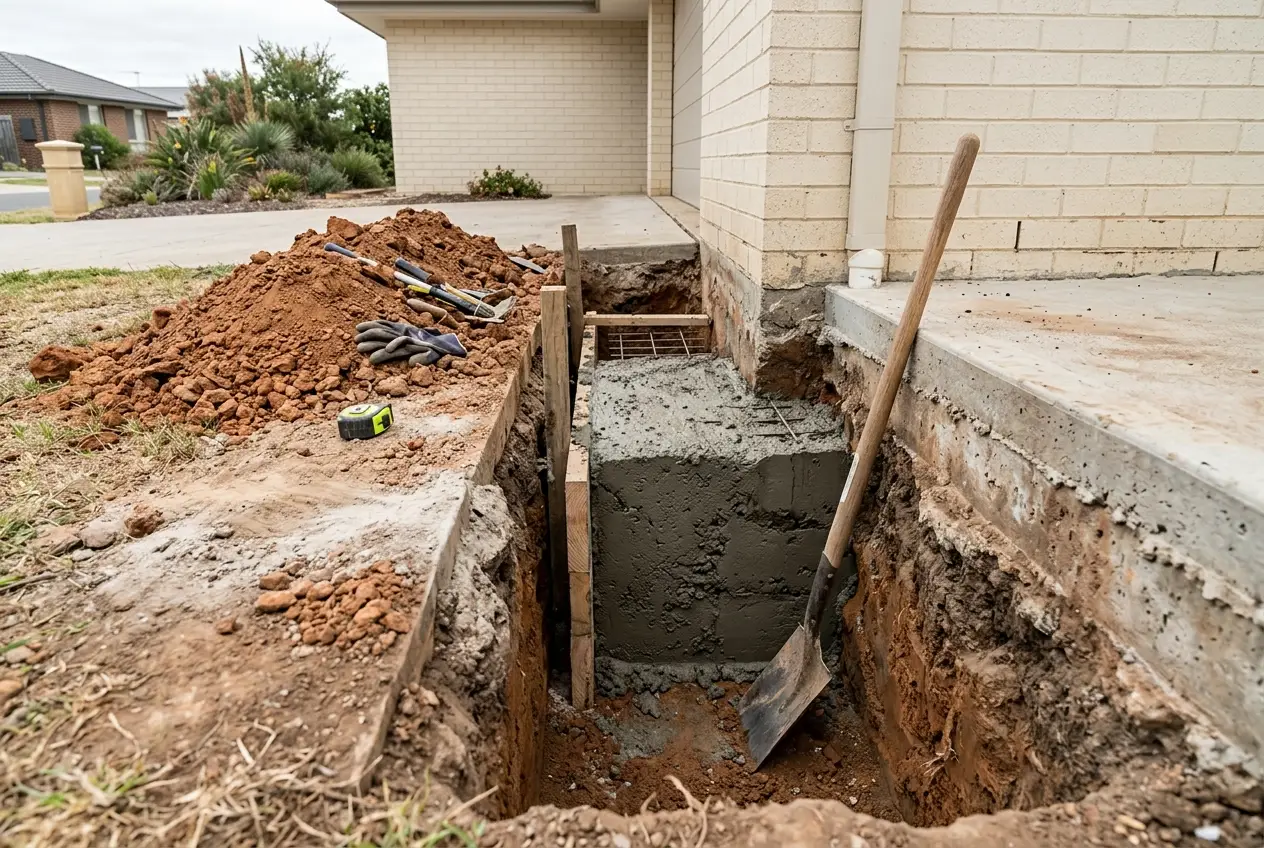
Williams Landing housing — what we are usually dealing with
Williams Landing was developed from around 2010 as a master-planned, transit-oriented estate, and the housing is uniformly modern: brick veneer on waffle-pod slab built under AS 2870, a high proportion of double-storey homes, on compact lots with minimal setbacks. The build quality is generally consistent and the slabs are compliant. What compact modern lots create is concentration — downpipes, air-conditioning condensate, irrigation, paving and narrow garden beds all crowded into the same metre-wide strip beside the footings, with very little room for water to disperse before it reaches the slab.
The ground under Williams Landing
The suburb sits on the Werribee coastal plain: reactive clay on very flat ground with a comparatively high water table, the same conditions that make neighbouring Point Cook a plumbing-first assessment. Low elevation and minimal fall mean drainage has little gradient to work with and the soil beneath a slab can stay wetter for longer than it would further inland. A leaking under-slab pipe that would dissipate on a well-drained site instead saturates the clay directly under the footings and keeps it there.
What this means for your job
An assessment in Williams Landing should include the plumbing before it includes a quote for piers. A leaking under-slab sewer or water line either washes fines out and causes localised settlement, or keeps the clay permanently swollen and causes heave — and from inside the house those look identical. A CCTV drain inspection and a static water test cost a few hundred dollars, frequently identify a repairable fault, and materially change both the scope and the insurance position, since most policies exclude gradual earth movement but may cover damage from a sudden burst pipe. On homes still inside the six-year structural defect window, an independent engineer's report before any repair is equally important.
What we see in Williams Landing homes
- Cracking concentrated near a bathroom, laundry or kitchen rather than spread across the house
- An unexplained rise in the water bill alongside new cracking
- Persistently damp or dark patches on a slab edge or in a garden bed against the house
- Cracks noticeably wider on the upper storey than at ground level
- Water pooling beside the house after rain with nowhere to drain
Underpinning costs in Williams Landing
$15,000 – $32,000 for typical underpinningPiers typically run $1,700 to $2,900 each. Spend the $400 to $900 on CCTV drain inspection and leak detection first — on this ground it regularly finds a repairable plumbing fault, and if it does, both the scope and who pays for it can change entirely.
Indicative range only, based on typical jobs in this area. Access, soil conditions and the extent of movement change the number — a fixed price follows an on-site inspection.
The right service for Williams Landing
Williams Landing is a slab-on-ground suburb, so there are no stumps to replace here — the service that applies is underpinning and foundation repair. Anyone offering you "restumping in Williams Landing" has not looked at what your house is built on. See how we assess slab movement, and how heave differs from settlement, on our underpinning page.
Underpinning in Williams Landing — your questions
Could a plumbing leak be cracking my Williams Landing home?
It should be one of the first things ruled out. Williams Landing is flat, low-lying and has a relatively high water table, so a leaking under-slab sewer or water service does not drain away — it saturates the clay directly beneath the footings. Depending on the pipe and the soil, that either washes out support and causes settlement or keeps the clay swollen and causes heave. A CCTV drain inspection and static water test are inexpensive and definitive, and if a leak is found, the repair path and the insurance position both change substantially.
My Williams Landing house is only about ten years old — is that normal?
Structural cracking at that age is not something to accept as normal settling. The slab is almost certainly compliant, so the question is what changed around it — a drainage fault, an under-slab leak, irrigation against one wall, or paving directing water back toward the house. It is also worth checking the completion date against Victoria's six-year domestic building insurance window for structural defects. Either way, establish the cause with an independent engineer before any repair, because repairs destroy the evidence.
Can Williams Landing homes be restumped?
No — there is nothing to restump. Every home in Williams Landing is brick veneer on a concrete slab poured on the ground, with no subfloor and no individual stumps. Restumping applies to pre-1970s homes with suspended timber floors, which is a different construction era found in the older inner suburbs. For a slab home the relevant services are underpinning, resin injection, drainage correction and crack repair.
We also work near Williams Landing
Worth reading next: Reactive clay in Melbourne's west, explained